The term complementary/alternative therapies refers to holistic methods of healing that differ from that a regular veterinarian does. It includes massage, acupressure, acupuncture, and aromatherapy. While these therapies should not entirely replace veterinarian care, especially in serious situations, they can be used in conjunction with it. For example, you can use massage therapy when your horse is injured in addition to have your vet come out.
Acupressure and Acupuncture
Acupressure is a form of therapy used in traditional Chinese medicine. Traditional Chinese medicine teaches that an energy flow, called the chi, runs along channels(meridians), through every person and animal, giving them balance and health. When this energy flow is blocked somehow, a health problem occurs. To fix this, a person must apply pressure on certain points along the meridians, depending on the health problem, to continue the flow of energy. Acupuncture works the same way, except small needles are used. According to the Illustrated Guide to Holistic Care for Horses, by Denise Bean-Raymond, both therapies have several benefits. Among these are a strengthened immune system, and increased blood flow, and reduced inflammation. If your horse has a disease or a fever, the veterinarian should be called to care for him. Also, do not perform acupressure/acupuncture until at least few after your horse has eaten and when he is completely cooled down from any recent exercise.
Aromatherapy
Aromatherapy uses extracts, called essential oils, from various beneficial plants, including lavender, chamomile, wintergreen, and clove, to benefit both physical and mental health. Some are very potent and should not be applied directly to skin, while others can safely by applied topically. Horses will often show that they need a certain oil by perking up their ears when they smell it, or pinning their ears if they do not need the oil at the time. You should only use pure, therapeutic grade essentials because the cheaper kinds may be diluted with harmful chemicals. It may be more expensive the buy therapeutic grade oils, but you can save money in the long run since they are more beneficial and do not have the chemicals others might have. If you would like to learn more about essential oils and using them for your horse, email me at paola.pedranti@gmail.com
Massage
Massages are something most of you are probably familiar with. Someone giving a massage will rub and knead the person's muscles, reducing discomfort and increasing blood flow. The same thing works in horses. Equine massage therapies work with their patients to relieve muscle tension and pain, cause the horse to become more relaxed and ready to learn, and prevent injuries. Massaging your own horse is also a way to bond. When combining it with essential oils, you can increased benefit from both the oils and the massage(see Raindrop Technique 1, 2).
Stretching
Although stretching isn't an alternative therapy, it does have its benefits. It causes muscles to become more supple, elastic, and flexible, preventing many injuries. Remember to never stretch a cold muscle. Stretching should be done after your horse warms up since stretching a cold muscle can cause it to become injured. Also remember not to strain the muscle too much when stretching it, gently lifting and stretching it. Hold it for a short amount of time at first(about 5 seconds) and over several days work your way up to about 15 seconds. If you horse seems agitated about you stretching a certain body part, release it.
These therapies can be beneficial, if done correctly. Remember that they are not meant to replace veterinarian, so if your horse becomes sick or injured, call you vet before attempting any of these therapies.

Showing posts with label natural health for horses. Show all posts
Showing posts with label natural health for horses. Show all posts
Wednesday, March 12, 2014

Friday, February 7, 2014
Understanding a Horse's Digestive System
Understanding your horse's digestive system, which is a bit different than our own, is an important step in keeping your horse healthy. Knowing what is going on as food is digested and the specific dietary needs of your horse can help you ensure that he is healthy. The major difference between a horse's digestive system and that of a human's is that horses have hundreds of bacteria, called microbes, in their hindgut(cecum and large colon). These microbes break down(ferment) the plant fiber into a usable energy.
A horse's digestive proccess is much like ours. It begins with the horse taking bites of food, grinding it into small, digestible pieces and swallowing it. From there, it travels to the stomach, which is quite compared to the rest of their body size, holding only two to four gallons. This is because horses are meant to eat many small meals all day long. Once in the stomach, acid and enzymes further break the food down, and it moves on to the next step: the small intestine(70-feet long). There, sugar, starch, protien, fats, vitamins, and minerals are absorbed before the remaining food travels to the hindgut(cecum and large colon). The cecum(three to four feet long) and large colon(ten to twelve feet long) store fluid to be used during prolonged exercise, while at the same time fermenting the food and providing 30 to 70% of a horse's energy. Finally, whatever is leftover enters the narrow, small colon, where 90% of the fluid is absorbed, and exits through the rectum.
Now that you know how everything works, you can better understand some of the problems that occur in the digestive tract.
Stomach Ulcers
Stomach ulcers are becoming increasingly more common among domesticated horses. This is due to the fact that domesticated horses are fed only several times a day, rather than being allowed to eat all day long as they do in the wild. Since a horse's stomach continuously produces stomach acid, whether he is eating or not, long periods of not eating can cause the acid to burn the stomach, creating an ulcer. Too much grain, intenste exercise, stress, and illness can also cause stomach ulcers. Symptoms can be a rough coat, poor performance, grinding of the teeth, and possibly colic-like symptoms. The only way to know how severe an ulcer is, or if your horse even has one, is by your veterinarian performing an endoscopy.
Prevention is the best cure, and can be done by feeding your horse several small, more frequent meals rather than two or three bigs ones, or allowing him to graze all day if possible. Reducing grain may also help. Essential oils, too, can assist with the prevention of stomach ulcers, according to Lisa Carter from Heavenly Gaits Equine Massage. She recommends three to five drops of copaiba oil between the lip and gum, taken two to three times a day.
Colic
There are several types of colic: impaction, gas, and intestinal twists. The first is caused by solid food becoming lodged inside of the digestive tract, and can be prevented by providing plenty of fresh, clean water for your horse to drink. Gas colic, as the name suggests, is when a horse becomes bloated and gassy. It can be caused by too much starchy grains or by a sudden change of diet and is not as serious as other kinds of colic. Torsion colic, or an intestional twist, is the worst, but also the most rare, kind. Only surgery can fix it. Since it usually isn't readily apparent what type of colic has occured, call you veternarian as soon as you notice any symptons.
Laminitis
Laminitis can also be very serious. It is an inflammation in the hooves and can be caused by a horse eating food high in non-structural carbohydrates(sugar, starch, etc.). Limiting concentrate feed(grain) to 1/2% of your horses body weight or less per meal can help prevent laminitis.
Understanding your horse's digestive system is a huge step in creating a healthy, happy horse.
A horse's digestive proccess is much like ours. It begins with the horse taking bites of food, grinding it into small, digestible pieces and swallowing it. From there, it travels to the stomach, which is quite compared to the rest of their body size, holding only two to four gallons. This is because horses are meant to eat many small meals all day long. Once in the stomach, acid and enzymes further break the food down, and it moves on to the next step: the small intestine(70-feet long). There, sugar, starch, protien, fats, vitamins, and minerals are absorbed before the remaining food travels to the hindgut(cecum and large colon). The cecum(three to four feet long) and large colon(ten to twelve feet long) store fluid to be used during prolonged exercise, while at the same time fermenting the food and providing 30 to 70% of a horse's energy. Finally, whatever is leftover enters the narrow, small colon, where 90% of the fluid is absorbed, and exits through the rectum.
 |
| Digestive system credit |
Now that you know how everything works, you can better understand some of the problems that occur in the digestive tract.
Stomach Ulcers
Stomach ulcers are becoming increasingly more common among domesticated horses. This is due to the fact that domesticated horses are fed only several times a day, rather than being allowed to eat all day long as they do in the wild. Since a horse's stomach continuously produces stomach acid, whether he is eating or not, long periods of not eating can cause the acid to burn the stomach, creating an ulcer. Too much grain, intenste exercise, stress, and illness can also cause stomach ulcers. Symptoms can be a rough coat, poor performance, grinding of the teeth, and possibly colic-like symptoms. The only way to know how severe an ulcer is, or if your horse even has one, is by your veterinarian performing an endoscopy.
Prevention is the best cure, and can be done by feeding your horse several small, more frequent meals rather than two or three bigs ones, or allowing him to graze all day if possible. Reducing grain may also help. Essential oils, too, can assist with the prevention of stomach ulcers, according to Lisa Carter from Heavenly Gaits Equine Massage. She recommends three to five drops of copaiba oil between the lip and gum, taken two to three times a day.
Colic
There are several types of colic: impaction, gas, and intestinal twists. The first is caused by solid food becoming lodged inside of the digestive tract, and can be prevented by providing plenty of fresh, clean water for your horse to drink. Gas colic, as the name suggests, is when a horse becomes bloated and gassy. It can be caused by too much starchy grains or by a sudden change of diet and is not as serious as other kinds of colic. Torsion colic, or an intestional twist, is the worst, but also the most rare, kind. Only surgery can fix it. Since it usually isn't readily apparent what type of colic has occured, call you veternarian as soon as you notice any symptons.
Laminitis
Laminitis can also be very serious. It is an inflammation in the hooves and can be caused by a horse eating food high in non-structural carbohydrates(sugar, starch, etc.). Limiting concentrate feed(grain) to 1/2% of your horses body weight or less per meal can help prevent laminitis.
Understanding your horse's digestive system is a huge step in creating a healthy, happy horse.
Friday, January 31, 2014
Keeping Your Horse Hydrated in Winter
When most people hear the word "dehydrated," they imagine it happening on hot, dry, 100 degree days to people(or horses) who do not drink enough water. However, dehydration can even occur in frigid, sub-zero temperatures, which is why it is important to let your horse have access to fresh water devoid of ice chunks. This can mean a lot of work, because a horse must drink eight to twelve gallons of water a day to remain healthful, but it will be worth it because it can help prevent illnesses, such as impaction colic.
There are several things you can do to encourage your horse to drink. If you live somewhere that gets below the freezing temperature during the day, you should break up the ice several times a day so the water doesn't completely freeze over. Better yet, if you have access to an immersion heater or electric teakettle, you can warm the water up just enough so it is not too chilling before giving it to your horse, which may encourage him to drink. Make sure the water is between 45 than 65 degrees Fahrenhiet, though, because horses tend not to drink water that is too cold or too warm.
Another trick is to feed your horse dry food, such as his meal of hay or grain, and let him eat a for a few minutes before refilling his water bucket. This causes his mouth to become dry, thus encouraging him drink water to relieve his thirst. Salt also makes a horse thirsty, so giving your horse access to a salt lick and lots of water may also encourage him to drink.
Mixing electrolytes into your horse's may also encourage your horse to drink more, or at the very least help to keep him hydrated.
Watch for signs of your horse being even just a little bit dehydrated. If his manure seems drier than normal, he may not be getting enough water and is probably dehydrated. Since dehydration means less saliva, a dehydrated horse may also eat less hay, grain, and other dry food because he can't produce enough saliva to chew it, thus causing him to lose a lot of weight and become sick. Probably the worst health issue caused by dehydration is impaction colic. Impaction colic, one of the worst kinds of colic, is caused by food becoming jammed in the intestines due to lack of moisture, a serious condition. The veterinarian should be called immediately.
Staying hydrated can keep your horse healthy and prevent illness caused by lack of water. Make sure your horse has access to fresh water all day so he remains hydrated and doesn't have to resort to eating snow, which is not an ideal subsitute for water. Hydration is important any time of the year, no matter how hot or cold it is.
 |
| Give your horse access to clean, ice-free water. credit |
There are several things you can do to encourage your horse to drink. If you live somewhere that gets below the freezing temperature during the day, you should break up the ice several times a day so the water doesn't completely freeze over. Better yet, if you have access to an immersion heater or electric teakettle, you can warm the water up just enough so it is not too chilling before giving it to your horse, which may encourage him to drink. Make sure the water is between 45 than 65 degrees Fahrenhiet, though, because horses tend not to drink water that is too cold or too warm.
Another trick is to feed your horse dry food, such as his meal of hay or grain, and let him eat a for a few minutes before refilling his water bucket. This causes his mouth to become dry, thus encouraging him drink water to relieve his thirst. Salt also makes a horse thirsty, so giving your horse access to a salt lick and lots of water may also encourage him to drink.
Mixing electrolytes into your horse's may also encourage your horse to drink more, or at the very least help to keep him hydrated.
Watch for signs of your horse being even just a little bit dehydrated. If his manure seems drier than normal, he may not be getting enough water and is probably dehydrated. Since dehydration means less saliva, a dehydrated horse may also eat less hay, grain, and other dry food because he can't produce enough saliva to chew it, thus causing him to lose a lot of weight and become sick. Probably the worst health issue caused by dehydration is impaction colic. Impaction colic, one of the worst kinds of colic, is caused by food becoming jammed in the intestines due to lack of moisture, a serious condition. The veterinarian should be called immediately.
Staying hydrated can keep your horse healthy and prevent illness caused by lack of water. Make sure your horse has access to fresh water all day so he remains hydrated and doesn't have to resort to eating snow, which is not an ideal subsitute for water. Hydration is important any time of the year, no matter how hot or cold it is.
Saturday, January 18, 2014
5 Common Sport Horse Injuries, Part 2
Continued. See Part 1
Bone Bruises
A bone bruise is bruising of the bone, commonly occuring in the cannon and pastern bone. It is caused when tremendous force is concentrated in one of these areas, causing damage to the bones. Fluid builds up inside the bone and swelling occurs. Because bone bruises are caused by a hard impact, this kind of injury is most common in jumpers and eventers, or horses that are worked on hard ground.
Bone bruises are very painful, despite the fact that they are small and hard to identify without proper equipment. Nuclear bone scans often view a bone bruise as a hot spot, yet pinpointing it exactly with that machine is difficult. The best way to locate it is by using a magnetic resonance imaging(MRI) scan.
The time the horse will need off varies depending on how bad the bruising is, but average he will need to rest for three months before continuing work. Veternarians recommend using anti-inflammatory medications, such as Equioxx, to help with the injury. According to Nan Martin, wintergreen, cypress, and helichrysum are great natural alternatives for bone injuries.
Inflammed Joints
Sometimes, the tissue lining a joint can become inflammed, which if not treated can eventually lead to osteoarthritis. This type of injury can occur in any horse, particularly when the horse's workload suddenly increases. Signs include soreness, stiffness, and less fluid gaits. His joints may swell and feel hot.
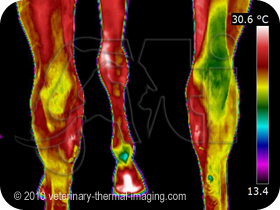 |
| The red represents inflammation. credit |
The best way to treat this injury is give the horse a stall rest and cold-hose his joints daily until they are no longer hot. You also want to reduce inflammation in his joints, which can be done using anti-inflammatory medication. According to Nan Martin, Thyme, Bergamot, and Eucalyptis have been known to work in the same manner. Recovery may take a week or more, depending on the severity of the inflammation. Once your horse has recovered, gradually increase his work load and plan the most intense workouts several days or more apart from each other.
Sore Muscles
It is natural for muscles to be a little sore after a workout, but sometimes they become strained, which commonly occurs in dressage horses, who must work hard to maintain a collected frame. As a result, his back may hurt and become stiff. He may also be resistant to bend, turning, and collecting.
In the scenario that the pain and stiffness does not disappear after rest, or it if reappears, search for other causes, such as a poorly fitting saddle or an unbalanced rider. Massage, chiropractic work, acupressure, or even a thorough currying have been known reduce soreness. Combining massage with essential oils is said to increase it's affectiveness.
***
Remember to always be aware of your horse's condition and well-being. Detecting problems early on can prevent more serious problems from arising, keeping your horse healthy and possibly saving you money in the long run.
Friday, January 17, 2014
5 Common Sport Horse Injuries, Part 1
Just like human athletes, sport horses, too, are prone to injuries. Jumping, when joints and muscles are strained on impact, can cause considerable damage, particularly if the horse misteps or stumbles, which can cause a torn ligament or tendon. Among the myriad injuries a horse can obtain, the most common are: suspensor ligament injuries, deep digital flexor tendon(DDFT) damage, bone bruises, inflamed joints, and sore muscles.
Suspensory Ligament Injuries
The suspensory ligament runs down the back of the cannon bone, starting just below the knee or hock and divinding into two branches, ending at the pastern. The ligament supports the ankle when weight is put on it, though if too much pressure is applied, it may tear or rupture. This can occur in the front legs when jumpers or eventers mistep upon landing on the other side of an obstacle, stressing the ligament. Dessage horses will most likely injure their hind leg suspensory ligaments as they work off their hind ends.
Spotting an injury in the suspensory ligament can prove difficult, since part of it is covered by other structures and the horse may only display subtle signs of lameness, depending on the severity of the tear. The leg may be warm, swollen, and sensitive. The best way to tell is by having your veterinarian exam you horse. An utlrasound can readily discover how severe the damage is and even locate the exact place of the tear. X-rays can show if the bone is damaged as well.
Depending on the severity of the situation, your vet will recommend several things. He will most likely tell you to cold-hose the leg daily, give your horse a stall rest, hand walk him short distances, and slowly return to the usual workload. This can take as short as eight weeks, or as long as a year. In more severe cases, your vet may recommend surgery or shockwave treatment.
Regardless of how severe the injury is, you should do something to reduce inflammation. Most vets recommend phenylbutazone(bute) and Banamine. Natural alternatives, recommended by Nan Martin, include lemongrass and marjoram, which is known to not only reduce inflammation and aid the healing of muscles, but also alleviates pain.
DDFT Damage
The deep digital flexor tendon, as the name suggests, assists with flexon of the leg. It runs from the back of the leg to the bottom of the coffin bone. Most commonly, a sport horse will the tear the bottom part, which runs from the pastern to the hoof, when his weight passes over his toe and his heel lifts. This occurs when jumping or working at high speeds, such as in the gallop.
Because the injury can occur to the part of the tendon residing in the hoof, spotting this condition can be particularly hard. If it occurs in the pastern or above the heal, you may notice it due to heat and swelling. Otherwise, it can be next to impossible to notice it, even with ultrasound, unless you go to a clinic with a magnetic resonance imaging machine.
Just like with a torn ligament, you should cold-hose the injured area and give your horse a stall rest of about eight weeks if the tendon has only been spranged, or eight months or more if the tendon has been torn. Try to reduce the inflammation to aid healing and reduce pain. As I mentioned earlier, lemongrass and marjoram are commonly used to reduce pain and inflammation. Your vet may recommend special shoes. Don't rush things, and slowly work your way up the training schedule you had before the injury.
Stay tuned for Part 2 to read about three more common injuries.
 |
| A diagram of the tendons and ligaments in the leg. Notice the suspensory ligament and deep digital flexor tendon. credit |
The suspensory ligament runs down the back of the cannon bone, starting just below the knee or hock and divinding into two branches, ending at the pastern. The ligament supports the ankle when weight is put on it, though if too much pressure is applied, it may tear or rupture. This can occur in the front legs when jumpers or eventers mistep upon landing on the other side of an obstacle, stressing the ligament. Dessage horses will most likely injure their hind leg suspensory ligaments as they work off their hind ends.
Spotting an injury in the suspensory ligament can prove difficult, since part of it is covered by other structures and the horse may only display subtle signs of lameness, depending on the severity of the tear. The leg may be warm, swollen, and sensitive. The best way to tell is by having your veterinarian exam you horse. An utlrasound can readily discover how severe the damage is and even locate the exact place of the tear. X-rays can show if the bone is damaged as well.
Depending on the severity of the situation, your vet will recommend several things. He will most likely tell you to cold-hose the leg daily, give your horse a stall rest, hand walk him short distances, and slowly return to the usual workload. This can take as short as eight weeks, or as long as a year. In more severe cases, your vet may recommend surgery or shockwave treatment.
Regardless of how severe the injury is, you should do something to reduce inflammation. Most vets recommend phenylbutazone(bute) and Banamine. Natural alternatives, recommended by Nan Martin, include lemongrass and marjoram, which is known to not only reduce inflammation and aid the healing of muscles, but also alleviates pain.
DDFT Damage
The deep digital flexor tendon, as the name suggests, assists with flexon of the leg. It runs from the back of the leg to the bottom of the coffin bone. Most commonly, a sport horse will the tear the bottom part, which runs from the pastern to the hoof, when his weight passes over his toe and his heel lifts. This occurs when jumping or working at high speeds, such as in the gallop.
Because the injury can occur to the part of the tendon residing in the hoof, spotting this condition can be particularly hard. If it occurs in the pastern or above the heal, you may notice it due to heat and swelling. Otherwise, it can be next to impossible to notice it, even with ultrasound, unless you go to a clinic with a magnetic resonance imaging machine.
Just like with a torn ligament, you should cold-hose the injured area and give your horse a stall rest of about eight weeks if the tendon has only been spranged, or eight months or more if the tendon has been torn. Try to reduce the inflammation to aid healing and reduce pain. As I mentioned earlier, lemongrass and marjoram are commonly used to reduce pain and inflammation. Your vet may recommend special shoes. Don't rush things, and slowly work your way up the training schedule you had before the injury.
Stay tuned for Part 2 to read about three more common injuries.
Thursday, December 12, 2013
Checking Your Horse's Vital Signs
One of the most important ways to check your horse's health is to observe his vital signs. These include pulse, respiration, temperature, and capillary refill time, the latter being how long it takes for color to return to the gums when you put pressure on them.
The normal temperature of a resting horse should be around 99 to 101 F(37.2 to 38.3 C). His heart should beat 36 to 40 times a minute, he should take 8 to 16 breathes a minute, and his capillary refill time should two or less seconds. Also, in a healthy horse, the gut should make a wide range of sound.
It is important to take your horse's temperature when he is resting, since horses get hotter when they exercise. Start by taking a thermometer, tying a long string securely to it, and insert it rectally, being careful not o get kicked. Wait a few minutes for the thermometer to get an accurate reading. Mercury ones take as long as three minutes, while digital ones can work as quickly as one minute. If you are uncertain, waiting a little longer never hurts. Just remember to keep a tight grip on the string. In a healthy horse, the temperature should read around 99 F, though you should not be concerned if it is a little bit lower. If it is higher however, the horse may be running a fever so you should call the vet. When you are done, make sure to clean the thermometer thoroughly.
A healthy, resting horse's pulse should be around 36 to 40 beats per minute. When taking the pulse, you may want to set a timer so you accurately measure it. Start by finding the main artery in the cheek and press inward and upward at the same time. If you don't feel the pulse there, try the artery on the inside of the leg, just under the knee.
To check a horse's respiration, stand next to his shoulder and watch his flank and stifle joint carefully. Every time they go in and out, count the breath. An average respiration is 8 to 16 breaths per minute, though it can vary depending on the size of the horse. ALso, make sure to check whether his breathing is labored or shallow. If so, call the vet.
You can check you horse's hydration by two ways: capillary refill time and a pinch test. The first is more reliable and involves pressing the horse's gum and checking to see how log it takes for the color to return. it should take only two seconds. Three or more should be a cause for concern and the vet should be called. While doing the test, check the color of the gum too. It should be bright pink, not pale yellow, dark red, or blue.
Another test you can do is pinching the skin above your horse's shoulder and seeing how long it takes for the pinched skin to flatten, which should happen right away. This test been disproved, though.
A final way to check your horse's health is gut sounds by putting your ear to his stomach. There should be a wide range of sounds. Silence usually means colic.
The normal temperature of a resting horse should be around 99 to 101 F(37.2 to 38.3 C). His heart should beat 36 to 40 times a minute, he should take 8 to 16 breathes a minute, and his capillary refill time should two or less seconds. Also, in a healthy horse, the gut should make a wide range of sound.
It is important to take your horse's temperature when he is resting, since horses get hotter when they exercise. Start by taking a thermometer, tying a long string securely to it, and insert it rectally, being careful not o get kicked. Wait a few minutes for the thermometer to get an accurate reading. Mercury ones take as long as three minutes, while digital ones can work as quickly as one minute. If you are uncertain, waiting a little longer never hurts. Just remember to keep a tight grip on the string. In a healthy horse, the temperature should read around 99 F, though you should not be concerned if it is a little bit lower. If it is higher however, the horse may be running a fever so you should call the vet. When you are done, make sure to clean the thermometer thoroughly.
 |
| You can check your horse's pulse using the artery on the leg. credit |
A healthy, resting horse's pulse should be around 36 to 40 beats per minute. When taking the pulse, you may want to set a timer so you accurately measure it. Start by finding the main artery in the cheek and press inward and upward at the same time. If you don't feel the pulse there, try the artery on the inside of the leg, just under the knee.
 |
| Another way to check the pulse is by using the artery in the cheek. credit |
To check a horse's respiration, stand next to his shoulder and watch his flank and stifle joint carefully. Every time they go in and out, count the breath. An average respiration is 8 to 16 breaths per minute, though it can vary depending on the size of the horse. ALso, make sure to check whether his breathing is labored or shallow. If so, call the vet.
You can check you horse's hydration by two ways: capillary refill time and a pinch test. The first is more reliable and involves pressing the horse's gum and checking to see how log it takes for the color to return. it should take only two seconds. Three or more should be a cause for concern and the vet should be called. While doing the test, check the color of the gum too. It should be bright pink, not pale yellow, dark red, or blue.
Another test you can do is pinching the skin above your horse's shoulder and seeing how long it takes for the pinched skin to flatten, which should happen right away. This test been disproved, though.
A final way to check your horse's health is gut sounds by putting your ear to his stomach. There should be a wide range of sounds. Silence usually means colic.
Wednesday, November 13, 2013
Winter Care for Horses: Dos and Not Dos
Winter is coming up. For some places, that means snow, for others, it means chilling rain. Regardless of where you are, it is essential to know how to feed and care for your horse in that particular season. Malory, at the Country Hitching Post, is doing a post about winter care, and I decided research and compile a list of 10 to do things and 10 not to do things.
To Do
Not to Do
 |
| Winter is almost upon us, so it is important to know how to care for your horse in this season. |
To Do
- If it is very cold(below freezing), rainy, windy, or/and snowy, feed your horse extra fiber. Hay works best, as the horse's body creates heat when digesting.
- Check your horses weight often, removing the blanket(if he has one) and feeling his body. It is very easy for him to lose weight in the winter.
- Make sure your horse's water hasn't iced over or is cold. Cold water may reduce drinking or cause colic, so it is beneficial to warm it up before giving it to your horse to drink. Bucket heaters may be available at your boarding barn or online, just remember not to let the water boil. Lukewarm is good enough.
- If it gets icy or snowy where you are, you may have to replace you horse's shoes with snow shoes, or take them off altogether. Snow shoes are made specifically for icy conditions, giving the horse more traction and preventing snow and ice from getting stuck in his shoe, possibly causing lameness. Often, it is best just to take the shoes off unless your horse needs them.
- Even if your horse has a winter coat, you may need to give him a light blanket if it is rainy or windy.
- Many people body clip their horses. If you do, make sure you have blankets for your horse, some that will protect him well enough in your climate. For some, than will just be a thin blanket. Others will need a thicker one.
- Some parasites survive, even in the winter, though this is more common in warmer climates, such as California. Make sure you deworm your horse to protect him from these parasites.
- Pick out your horses hooves daily, getting rid of snow and ice buildup.
- Warmer climates can also mean thrush, a hoof ailment that causes the frog to produce a black, oily substance.
- Many horses do well if they are kept outside. However, they should always have access to a shelter, such as a three-sided run-in.
Not to Do
- Do not let your horse's water trough freeze over or get too cold.
- Do not let your horse just sit around in the pasture. He needs exercise! Try to ride him as often as possible, even if that means ride in the cold. Snow sometimes gets in the way, and not all people have access to an indoor, so lungeing him or turning him out to a paddock or pasture for a little bit will work out just fine.
- Do not ride to hard if your horse is out of shape. Sometimes you only have time for an occasional ride or only ride when the weather isn't terrible. If you do, take care not to overwork your horse. Start out small and work up to more difficult exercises.
- Do not keep your horse indoors all winter. it is more healthy for the horse to be turned out with a shelter to keep out the wind, rain, and snow. However, if it is not possible to keep him outdoors, at least keep doors and windows open in the barn to allow airflow and take your horse out daily.
- Do not over-blanket. This is a common mistake among newbies. They see their un-blanketed horse out in the freezing cold paddock and think, "The poor thing must be cold," giving him a blanket or two. Horses do not get as cold as people do. often, a winter coat and a thin blanket is good enough.
- Do not neglect to care for your horses hooves. Some people do not do this when it is cold, but in reality, horses may need even more hoof care in the winter, when ice can buildup in there hooves.
- Do not forget to groom. Your horse needs to be groomed, even in the cold. This keeps him healthy and clean.
- Do not let your horse sit in the pasture without touching him until the spring. Daily maintenance–grooming, hoof picking, watering, feeding–can be hard when it is freezing outside and you prefer to sit by the toasty fire, but it needs to be done.
- Do not forget to give him extra fiber. This includes hay, and sometimes even corn oil.
- Do not forget about yourself! While it is important that your baby is taken care, do not forget about taking care of yourself. Bundle up. Wear gloves and toe warmers. Do whatever it takes to stay warm and healthy while taking care of your horse. the last thing you want is to catch a cold.
Wednesday, November 6, 2013
Naturally Treat a Horse's Wounds
Horses tend to get themselves into a lot of scrapes, sometimes coming out of the pasture with cuts or wounds on them. While these wounds generally aren't serious, it is still helpful to learn how to treat these them, preventing infection and helping them to heal more quickly.
The first thing to do if your horse comes out of the pasture with a wound is to check how serious it is. Is the wound just a slight cut or is it deep enough to require stitches? It is not really necessary to call the veterinarian it the wound is not deep or does not have a flap of skin hanging off. Use your best judgement.
Next, clean out the wound as best as you can and apply an ointment or spray. I use the Animal Scents Ointment for my dog when she gets wounds. It can be mixed with five drops each of Thieves, Melrose, and Helichrysum for every tablespoon of ointment. It is helpful to set aside a small amount of the ointment as you will not be using the whole container. Apply the ointment several times a day. Don't use a lot–a little goes a long way.
Something that I often use, both for myself and for my dog, is a mist spray. I pour some distilled water into a small glass spritz bottle and mix several different anti-infectious oils in with it. I generally use Purification, although lavender, Melrose, helichrysum, myrrh, and other anti-infectious oils can be used in addition to or in place of Purification. This spray can be sprayed several times a day or as often as needed.
If the wound is bleeding a lot, take some sterile gauze and hold it to the wound to stop the bleeding. If you plan on putting your horse in the pasture, or even his, it's a good idea to keep the gauze on; it will help keep the wound clean and prevent in infection. Take the bandage off several times a day to spray it or put ointment on it, then put it back on. You can use both the spray and the ointment, but if you do, you should apply the ointment after the spray.
The first thing to do if your horse comes out of the pasture with a wound is to check how serious it is. Is the wound just a slight cut or is it deep enough to require stitches? It is not really necessary to call the veterinarian it the wound is not deep or does not have a flap of skin hanging off. Use your best judgement.
 |
| click to enlarge. |
Something that I often use, both for myself and for my dog, is a mist spray. I pour some distilled water into a small glass spritz bottle and mix several different anti-infectious oils in with it. I generally use Purification, although lavender, Melrose, helichrysum, myrrh, and other anti-infectious oils can be used in addition to or in place of Purification. This spray can be sprayed several times a day or as often as needed.
If the wound is bleeding a lot, take some sterile gauze and hold it to the wound to stop the bleeding. If you plan on putting your horse in the pasture, or even his, it's a good idea to keep the gauze on; it will help keep the wound clean and prevent in infection. Take the bandage off several times a day to spray it or put ointment on it, then put it back on. You can use both the spray and the ointment, but if you do, you should apply the ointment after the spray.
Wednesday, October 30, 2013
Natural Treatment for Saddle Sores
When being ridden, a horse may develop saddle sores–wounds caused by ill-fitting tack, unbalanced riders, or people who ride their horse to roughly. Chafing of the saddle can will create little inflamed abrasions, and continuous use of the poorly-fitting saddle will worsen the wound. Sometimes, after the wound has healed, white hair will grow back where the sore once was, permanently marking the spot.
There are several types of saddle sores: saddle galls, an abrasion caused by the tack rubbing parts of the skin; and heat rashes, rashes caused by dirty saddle pads or even allergic reaction to a synthetic pad. Heat rashes can turn into saddle sores if the cause is left unfixed.
Once a horse has a saddle sore, you should immediately find the problem and fix it. Does the saddle not fit? Are you leaning a little to one side when you ride instead of staying centered in the saddle? Is the pad wrinkled? Does it have dirt, leaves, or other lumps on it? Once you discover what the problem is, you can work on fixing it. The best thing to do is to stop riding for a week or two until the sore heals completely.
According to the Animal Desk Reference, there are several oils that can be used to help heal the saddle sore, whether is is raw, something that occurs in extreme cases, or just slightly swollen. The book recommends applying several drops of Melrose or/and Idaho balsam fir on the wound daily. Other excellent oils include Roman chamomile, geranium, helichrysum, lavender, and myrrh. You can also use the Animal Scents Ointment one to two times a day, mixing a small amount of it with some of the above oils if desired.
Of course, prevention is the best cure. Before tacking up, you should make sure your horse doesn't have an dirt on his back, brushing him down if necessary. Make sure the saddle pad is smooth before you place the saddle on his back. If you need to adjust the saddle, do not slide it forward, an act that can wrinkle both the saddle pad and the horses hair. Instead, lift it and set it into place.
There are several types of saddle sores: saddle galls, an abrasion caused by the tack rubbing parts of the skin; and heat rashes, rashes caused by dirty saddle pads or even allergic reaction to a synthetic pad. Heat rashes can turn into saddle sores if the cause is left unfixed.
 |
| Click to enlarge. |
Once a horse has a saddle sore, you should immediately find the problem and fix it. Does the saddle not fit? Are you leaning a little to one side when you ride instead of staying centered in the saddle? Is the pad wrinkled? Does it have dirt, leaves, or other lumps on it? Once you discover what the problem is, you can work on fixing it. The best thing to do is to stop riding for a week or two until the sore heals completely.
According to the Animal Desk Reference, there are several oils that can be used to help heal the saddle sore, whether is is raw, something that occurs in extreme cases, or just slightly swollen. The book recommends applying several drops of Melrose or/and Idaho balsam fir on the wound daily. Other excellent oils include Roman chamomile, geranium, helichrysum, lavender, and myrrh. You can also use the Animal Scents Ointment one to two times a day, mixing a small amount of it with some of the above oils if desired.
Of course, prevention is the best cure. Before tacking up, you should make sure your horse doesn't have an dirt on his back, brushing him down if necessary. Make sure the saddle pad is smooth before you place the saddle on his back. If you need to adjust the saddle, do not slide it forward, an act that can wrinkle both the saddle pad and the horses hair. Instead, lift it and set it into place.
Wednesday, October 23, 2013
Natural Treatments for Thrush
Thrush is a hoof infection that many horse owners are aware of. It is caused by not properly caring for the hooves, especially in a wet, muddy environment, or by not mucking out the horses stall and or not changing the bedding often enough. This buildup of moist debris allows bacteria, commonly Fusobacterium necrophorum, to grow in the hoof. The result is a frog with a putrid-smelly, greasy black substance coming from. If caught early enough, you can stop the infection from spreading to inside of the hoof, causing lameness. A good way to prevent thrush is by regularly scheduling your farrier visits and making sure your horse's paddock and stall is clean and dry.
If your horse gets thrush, the first thing you have to do is get him to a dry, clean environment. Make sure to pick out his hooves daily. Thus prevents more bacteria from building up. A helpful strategy is to use a popsicle stick to clean the frog and heel bulbs.
You should also make sure you disinfect to the kill the bacteria. According to Melissa Shelton, DVM, you apply several drops of Thieves oil blend directly to the affected area two to four times a day or as often as needed. Other oils you can apply are cassia, cinnamon, eucalyptus globulus, lavender, lemongrass, marjoram, melaleuca, alternifolia, mountain savory, ocotea, oregano, black pepper, and thyme. You can also use the following oil blends in addition to the Thieves oil blend: Abundance, Exodus II, Melrose, Purification, R.C.(Respiratory Congestion), Thieves Household Cleaner, and Thieves Spray.
It is important that you use at least one of these oils several times a day on the infected hoof. Apply several drops of the oil directly onto the infected and clean out the hoof. Also, it is important to talk to your farrier if your horse gets thrush, as he may be able to help by shoeing your horses(if he isn't already) and trimming his hooves regularly.
If your horse gets thrush, the first thing you have to do is get him to a dry, clean environment. Make sure to pick out his hooves daily. Thus prevents more bacteria from building up. A helpful strategy is to use a popsicle stick to clean the frog and heel bulbs.
 |
| Click to enlarge |
You should also make sure you disinfect to the kill the bacteria. According to Melissa Shelton, DVM, you apply several drops of Thieves oil blend directly to the affected area two to four times a day or as often as needed. Other oils you can apply are cassia, cinnamon, eucalyptus globulus, lavender, lemongrass, marjoram, melaleuca, alternifolia, mountain savory, ocotea, oregano, black pepper, and thyme. You can also use the following oil blends in addition to the Thieves oil blend: Abundance, Exodus II, Melrose, Purification, R.C.(Respiratory Congestion), Thieves Household Cleaner, and Thieves Spray.
It is important that you use at least one of these oils several times a day on the infected hoof. Apply several drops of the oil directly onto the infected and clean out the hoof. Also, it is important to talk to your farrier if your horse gets thrush, as he may be able to help by shoeing your horses(if he isn't already) and trimming his hooves regularly.
Wednesday, September 11, 2013
Homemade Horse Treats
Almost everyone loves to feed their horses treats---lots of them. Horses can be found nibbling at their owner's pockets, searching for a peppermint or a horse biscuit. Have you ever considered the benefits of homemade treats? For people who love to bake, they can be a cheaper, and possibly even healthier, alternative to store-bought biscuits. I've been going through an old horse health magazine that my dad picked up from New Zealand several years ago and found some recipes for homemade herbal biscuits.
Biscuits for a Healthy Coat
2 cups feed(pellets or whatever you usually use)
2 cups rolled oats
1 ounce dried nettle powder
30 grams dried mint leaves, crumbled(brings out dapples)
1 cup flax seeds(fatty acids to make healthy coat)
1 cup molasses
1/4 cup of brown sugar
1 cup of old fashioned oats
1/2 cup shredded carrot
1 cup oatmeal(quick oats)
1/4 molasses
1/4 water
1/4 dried rose hip powder
2 tablespoons dried ginger powder
30 grams dried chamomile flowers
1 cup flour
1 teaspoon sugar
1/2 teaspoon salt
Herbal Biscuits
3 cups unbleached flour
1/2 cup water
1/4 cup dried parsley
2 tablespoons garlic powder
1/4 barley grass powder
30 grams dried goat milk
1/4 cup vegetable oil
tis post has been linked to the HomeAcre Hop.
Biscuits for a Healthy Coat
2 cups feed(pellets or whatever you usually use)
2 cups rolled oats
1 ounce dried nettle powder
30 grams dried mint leaves, crumbled(brings out dapples)
1 cup flax seeds(fatty acids to make healthy coat)
1 cup molasses
1/4 cup of brown sugar
- Preheat oven to 356 F(180 C) and lightly grease the cookie sheet you will be using.
- Combine all of the ingredients. If it doesn't have a sticky enough consistency, add a little water.
- Drop the mixture onto the greased cookie sheet by the spoonful.
- Bake for an hour, then let them cool for another hour before removing them from the tray. Store in an airtight container.
- Feed to your horse!
 |
| Horses love being fed treats. source |
1 cup of old fashioned oats
1/2 cup shredded carrot
1 cup oatmeal(quick oats)
1/4 molasses
1/4 water
1/4 dried rose hip powder
2 tablespoons dried ginger powder
30 grams dried chamomile flowers
1 cup flour
1 teaspoon sugar
1/2 teaspoon salt
- Preheat oven to 356 F(180 C) and grease a cookie sheet.
- Stir ingredients well. It should come out as a sticky mixture.
- Scoop out a heaping spoonful of the mixture, then roll in your hands until it forms into a ball. Set on the greased cookie sheet and repeat until all the mixture is used.
- Bake for five to ten minutes or until golden brown. This treat can be stored at room temperature in a jar.
- Feed to your horse with lots of love!
Herbal Biscuits
3 cups unbleached flour
1/2 cup water
1/4 cup dried parsley
2 tablespoons garlic powder
1/4 barley grass powder
30 grams dried goat milk
1/4 cup vegetable oil
- Combine the dry ingredients together. Then add the water and oil.
- Knead the dough on a floured board and roll until it is about one inch(25 millimeters) thick.
- Let it stand for 30 minutes before cutting into squares.
- Place in 356 F(180 C) oven. Check every three minutes; they burn easily.
- Feed to your horse!
tis post has been linked to the HomeAcre Hop.
Thursday, August 8, 2013
Twelve Plants NOT to Have in Your Pasture
No matter what part of the country you live in, there will always be poisonous plants to watch out for---blue bonnets in the South and oleanders in the West, to name a few. Because they can be potentially dangerous to your horse, make sure to rid your pasture and the surrounding area of any of the plants i will mention below. Also make sure to contact your local U.S. Department of Agriculture Cooperative Extension office for more extensive list of poisonous plants near you.

Bracken Fern(Pteridum aquilinum): Bracken fern is a two to three feet tall perennial fern with triangular leaves. It is seen throughout the country, except in dry deserts, and can be found woodlands; wet, open fields; and any other moist climate. When eaten, it can cause depression, loss of coordination, blindness, and other neural dysfunctions. Call your vet immediately if you suspect your horse has eaten a bracken fern. For the next two weeks or so, your vet will administer large doses of thiamin to your horse.
 |
| Hemlock |
Hemlock(Conium maculatum): Hemlock is another perennial plant. Growing to be up to six feet tall, this parsley-like plant looks similar to Queen Anne's lace, except for the fact that it has purple spots near the base of the stem. It is seen all around the country, usually near roadsides or in open areas. Symptoms of eating hemlock usually appear within an hour of eating it. The horse may appear nervous, colicky, and trembly, and may lose coordination, breathe heavily, and his heart may slow. There is no cure. Death often occurs from failure in the respiratory system. If the horse consumed only a little, the veterinarian may be able to help.
 |
| Johnsongrass (Sudan grass is similar to Johnsongrass) |
Johnsongrass and Sudan Grass(Sorghum halepense and Sorghum bicolor subsp. drummondii): Johnsongrass and Sudan grass are often seen along roadsides in the South, as well as in open areas. They are tall, coarse grasses with large, veined leaves and multi-branched seed heads. Symptoms include: fast respiration, tremors, and constant urination or defecation. drugs can slow these effects.
 |
| Locoweed |
Locoweed(Astragalus spp. or Oxytropis spp.): Locoweed is a short, leafy plant with white or purple flowers, and grows in small tufts throughout the deserts in the West and Southwest. It causes a horse to act very oddly. Severity of symptoms depend on how much was consumed, and may include raising its legs high, staggering, and nodding its head. The symptoms are permanent.
 |
| Milkweed |
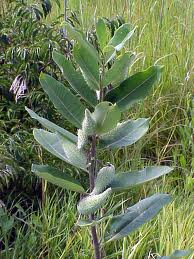
Milkweed(Asclepias spp.): Milkweed, the Monarch butterfly's primary food source, is toxic to all equines. It is found in both dry and swampy areas in the United States. When cut or broken, it secretes a milky substance(thus its name). All parts of this plant, including the narrow leafs(broad in some cases) and the fruit, a silky pouch filled with seeds, are poisonous. A horse that has consumed milkweed will lose of coordination, salivate, have seizures, and even become colicky. If not treated with gastrointestinal detoxification and the treatment for heart arrhythmias immediately, the horse could die within two days.
 |
| Oleander |

Oleander(Nerium oleander): Oleander is a tall, evergreen shrub with large clusters of white, pink, or red flowers, and is popular in hot, arid climates, particularly the West. Symptoms, with occur shortly after ingestion. They may include colic, respiratory distress, an irregular heart, and a pulse that is either very slow or very fast. Early treatment and veterinarian care is paramount. Activated charcoal can be used to slow the toxins, and drugs are used to stabilize the heart.
 |
| Red Maple |

Red Maple Tree(Acer rubrum): Red maple trees, a common type tree found all over North America, has green leaves that turn scarlet in the fall. Symptoms can appear in a few days or even a few hours. They include: lethargy, refusal of food, red or black urine, pale yellow or dark brown mucus membranes, dehydration, and rapid heartbeat. The veterinarian will give the affected horse lots of IV fluids, an amy even give it a blood transfusion. If care was prompt a very little leaves were eaten, the horse will most likely recover.
 |
| Russian Knapweed |
Russian Knapweed and Yellow Star Thistle(Acroptilon repens and Centauria solstitialis): Yellow star thistle has round yellow flowers in between sharp spines. Russian knapweed is similar, except
 |
| Yellow Star Thistle |
the flowers are purple or white and there are no spines. Both grow along roadsides, in fields, and in pastures throughout the West(every state from Missouri to California). Symptoms, which are permanent, include inability to chew properly and clenched facial muscles.
Tansy Ragwort(Senecio spp.): Tansy ragwort, a biennial weed, looks like little rosettes the first year adn progress to multi-stemmed flowers the second. Their flows are flat and daisy-like. One-hundred-twleve species exist in the United States, but fortunately only seven are poisonous to
 |
| Tansy Ragwort |
livestock. They appear along roadsides and in pastures. Symptoms are hard to see until signs of liver failure begin to appear. There is no cure.
Yew(Taxus spp.): Yew, an evergreen shrub, has flat, needle-like leaves and red or yellow berries with a black seed on the end. Sometimes yew trimmings are thrown into pastures. Symptoms include trembling and rapid heart rate. There is know treatment, and sudden death is not uncommon.
This post has been linked to the HomeAcre Hop.
 |
This post has been linked to the HomeAcre Hop.
Thursday, July 18, 2013
Causes of Laminitis(Grass Founder)
For many horse owners, watching their horse grazing in a lush, green pasture can be an ideal image, but any horse with equine metabolic syndrome(EMS) or Cushing's disease(pituitary pars intermedia dysfunction, aka PPID) are at risk for laminitis, also known as grass founder.
If a horse or pony with EMS will often show telltale symptoms, including being slightly obese, insulin resistant, or having recurrent laminitis. Even if they are not fat they may have fat deposits along the crest of the neck, dock and eyes. This condition most often occurs in horses and ponies that developed under harsh climates and are usually easy keepers.
Horses with PPID, a condition that occurs mostly in horses over fifteen, have patchy deposits and insulin resistance, just like EMS horses, but also have additional symptons. These include loss of topline muscle and a thick coat that sheds later than usual, or even never at all.
If your horse has any of these conditions, keep a careful eye on them to make sure they don't develop laminitis.
Carbohydrates
Carbohydrates play a major role in causing laminitis. Grazing in a pasture that is high in non-structural carbohydrates(NSCs), meaning fructan, sugar, and starch, is dangerous and can cause laminitis. On the other hand, structural carbohydrates, the fibrous part of the cell wall that gives a plant rigidity, are digested differently NSCs.
Most pople believe that fructan is the sole cause for laminitis, but that is simply not true. Fructan is not found in springtime grass, when many horses are known to founder, and further study can prove that conditions that create high fructan concentrations in forage also raise sugar and starch level. This means that NSCs in general can be attributed to grass founder.
Temperature: Kathryn Watts, a researcher specializing in pasture grass and laminitis-prone horse once said that if it is below 40 degrees Fahrenheit( approximately 4.4 Celsius) the enzymes that help plants grow simply won't function. As a result, sugar, caused by photosynthesis, continues to build up. NSCs can double or even triple if those conditions(sunny and below 40 degrees) last for several weeks. Since that happens in the fall and spring in many parts of the country, those seasons are associated with grass founder.
Lack of Fertilizer: Lack of fertilizer(nitrogen) can also cause laminitis. Even though the plant may have plenty of sugar stored up in it, without nitrogen it cannot use the excess sugar, which continues to pile up. Watts said, "I use the analogy of an assembly line: If the plant does not have all of the elements it needs to grow, the line shuts down and the other raw materials pile."
Because lack of nitrogen can be potentially dangerous, make sure that the pasture is properly fertilized. Watts suggests using a fertilizer with moderate fertility, not maximum.
Drought: Right now, in the middle of summer, drought can be the biggest cause of founder, especially because of the heatwave that has been striking most of the country. Drought also causes sugar to build up in grass. In Texas, summer is founder season. Fructan in cool-season grasses turns to sugar during a drought, "increasing the chances of metabolically driven laminitis."(Watts)
Mature Grass: You should always mow the pasture before the sugary, starchy seed head appears. Horses will often pick around other grass to eat the heads off the mature grass, which can cause founder.
Weeds: Most pastures are filled with weeds, which often contain more sugar than grass. The weeds containing the most NSCs are dandelion, thistle, and plantain. Often, killing off the broadleaf weeds, such as dandelions, with herbicide is enough to reduce the risk of founder.
While having thick, healthy grass may be enough to reduce weeds and the amount of sugar per mouth full of grass, there may still be more grass per acre, which also means more sugar per acre. When a pasture has been previously overgrazed and now has an abundance of grass, you may want to limit grazing time.
Weeds can also grow in dry lots, where horses and ponies are housed to keep them out of the pasture. Since horses can still founder of the small amount of weeds, your best bet is to through there with a weed-wacker, knocking down every single weed.
If a horse or pony with EMS will often show telltale symptoms, including being slightly obese, insulin resistant, or having recurrent laminitis. Even if they are not fat they may have fat deposits along the crest of the neck, dock and eyes. This condition most often occurs in horses and ponies that developed under harsh climates and are usually easy keepers.
Horses with PPID, a condition that occurs mostly in horses over fifteen, have patchy deposits and insulin resistance, just like EMS horses, but also have additional symptons. These include loss of topline muscle and a thick coat that sheds later than usual, or even never at all.
If your horse has any of these conditions, keep a careful eye on them to make sure they don't develop laminitis.
Carbohydrates
Carbohydrates play a major role in causing laminitis. Grazing in a pasture that is high in non-structural carbohydrates(NSCs), meaning fructan, sugar, and starch, is dangerous and can cause laminitis. On the other hand, structural carbohydrates, the fibrous part of the cell wall that gives a plant rigidity, are digested differently NSCs.
Most pople believe that fructan is the sole cause for laminitis, but that is simply not true. Fructan is not found in springtime grass, when many horses are known to founder, and further study can prove that conditions that create high fructan concentrations in forage also raise sugar and starch level. This means that NSCs in general can be attributed to grass founder.
Conditions to Watch Out For
Even if you don't have any high-risk horses, it is best to watch out for founder-causing conditions.Temperature: Kathryn Watts, a researcher specializing in pasture grass and laminitis-prone horse once said that if it is below 40 degrees Fahrenheit( approximately 4.4 Celsius) the enzymes that help plants grow simply won't function. As a result, sugar, caused by photosynthesis, continues to build up. NSCs can double or even triple if those conditions(sunny and below 40 degrees) last for several weeks. Since that happens in the fall and spring in many parts of the country, those seasons are associated with grass founder.
Lack of Fertilizer: Lack of fertilizer(nitrogen) can also cause laminitis. Even though the plant may have plenty of sugar stored up in it, without nitrogen it cannot use the excess sugar, which continues to pile up. Watts said, "I use the analogy of an assembly line: If the plant does not have all of the elements it needs to grow, the line shuts down and the other raw materials pile."
Because lack of nitrogen can be potentially dangerous, make sure that the pasture is properly fertilized. Watts suggests using a fertilizer with moderate fertility, not maximum.
 |
| This may be your dream pasture for your horse, but you should always watch out for signs of founder. (credit) |
Mature Grass: You should always mow the pasture before the sugary, starchy seed head appears. Horses will often pick around other grass to eat the heads off the mature grass, which can cause founder.
Weeds: Most pastures are filled with weeds, which often contain more sugar than grass. The weeds containing the most NSCs are dandelion, thistle, and plantain. Often, killing off the broadleaf weeds, such as dandelions, with herbicide is enough to reduce the risk of founder.
While having thick, healthy grass may be enough to reduce weeds and the amount of sugar per mouth full of grass, there may still be more grass per acre, which also means more sugar per acre. When a pasture has been previously overgrazed and now has an abundance of grass, you may want to limit grazing time.
Weeds can also grow in dry lots, where horses and ponies are housed to keep them out of the pasture. Since horses can still founder of the small amount of weeds, your best bet is to through there with a weed-wacker, knocking down every single weed.
*************
Next week I will continue to write about grass founder, next time featuring how to prevent it and how to treat its early stages.
This post has been linked to: The Home Acre Hop
This post has been linked to: The Home Acre Hop
Thursday, July 11, 2013
Snakes and Horses
Summer is here, and almost everyone is ready to enjoy some time with their horse during the long days. However, snakes pose a great hazard, especially if you live in a hot, dry climate with long grass. People living in Western and Eastern states are on the lookout for rattlesnakes, the most common type in the area. In the Southeast, you are most likely watching for water moccasins and copperheads, who live in humid climates. No matter where you live, though, snakes are most likely a major concern during the summer for both you and your horse.
Snake bites in horses most often occur when a horse is grazing and is bitten on the muzzle by a resting snake. When that happens, the horse's muzzle will quickly begin to swell, possibly blocking his airways. He may begin to appear depressed before the swelling even begins. If you see a pair punctures in the horse's muzzle, tell-tale signs that he has been bitten, phone the veterinarian immediately.
While you wait, keep a close eye on the horse, making sure that he doesn't show any signs of respiratory distress. If he does, insert a syringe case, a segment of a garden hose, or another tubular item as far as you can into his nostrils so that he can breathe as his face continues to swell.
Be warned that snake bites can become infected with bacteria from the Clostridia family, which can cause infections such as tetanus or sepsis.
Fortunately, no venom is injected in almost 20% of rattlesnakes, and most adult horses survive, even if venom is injected. However, bites are most deadly when inflicted to one of the horse's lower limbs. As the wound swells, the blood flow into the limb can become restricted, and a near fatal crisis can occur.
Veterinary treatment for snake bites uses anti-inflammatory medications and antibiotics since antivenin is expensive and most horse respond well to other treatments for snake bites anyways.
While waiting for the vet to arrive, try spraying the wound with Melrose and Purification to reduce infection. Clove can also be helpful to fight infection.
Make sure to closely monitor any horse that has been bitten, even if medical treatment has already been administered. Ensure that he is able to breathe, eat, and drink properly. Also, keeping him in a stable until he is well is advised because some cases can cause altered liver function, which photosensitivity. Keeping a photosensitive horse in the sun can have adverse effects to his body and skin.
One way to prevent snake bites is to make sure no rodents get in the stable. Store food where rodents can't get to them, preferably in a rodent-proof container, thus attracting less snakes. Also, if you live in an area where snakes such as water moccasins and cottonmouths regularly patrol the waterways, check for them before leading your horse in to drink.
This post is linked to: The Home Acre Hop
 |
| Always watch for venomous snakes, such as this rattler. (credit) |
While you wait, keep a close eye on the horse, making sure that he doesn't show any signs of respiratory distress. If he does, insert a syringe case, a segment of a garden hose, or another tubular item as far as you can into his nostrils so that he can breathe as his face continues to swell.
Be warned that snake bites can become infected with bacteria from the Clostridia family, which can cause infections such as tetanus or sepsis.
Fortunately, no venom is injected in almost 20% of rattlesnakes, and most adult horses survive, even if venom is injected. However, bites are most deadly when inflicted to one of the horse's lower limbs. As the wound swells, the blood flow into the limb can become restricted, and a near fatal crisis can occur.
Veterinary treatment for snake bites uses anti-inflammatory medications and antibiotics since antivenin is expensive and most horse respond well to other treatments for snake bites anyways.
While waiting for the vet to arrive, try spraying the wound with Melrose and Purification to reduce infection. Clove can also be helpful to fight infection.
Make sure to closely monitor any horse that has been bitten, even if medical treatment has already been administered. Ensure that he is able to breathe, eat, and drink properly. Also, keeping him in a stable until he is well is advised because some cases can cause altered liver function, which photosensitivity. Keeping a photosensitive horse in the sun can have adverse effects to his body and skin.
One way to prevent snake bites is to make sure no rodents get in the stable. Store food where rodents can't get to them, preferably in a rodent-proof container, thus attracting less snakes. Also, if you live in an area where snakes such as water moccasins and cottonmouths regularly patrol the waterways, check for them before leading your horse in to drink.
This post is linked to: The Home Acre Hop
Wednesday, July 3, 2013
Insect-Borne Illnesses and Horses
Insect-Borne Diseases
It's summer, and bugs, ranging from flies to mosquitoes, can be found everywhere. Besides being irritating for both you and your horse, they can carry all manners of diseases. Fortunately, horses are vaccinated against Equine encephalitis and West Nile Virus, two of the most common ones for mosquitoes to spread.
Flies, too, can spread diseases. Among them are Equine infectious anemia(similar to HIV), which causes the body to waste away. Horses are vaccinated against EIA and are annually tested(Coggins test).
Furthermore, flies can carry parasites. Bot flies lay their yellow eggs on a horse's leg, where he is most likely to lick them off, continuing their life cycle in the horse's stomach. Black flies spread onchocerca cervicals, a hair-loss causing parasite.If Onchocerca spreads to the eye, it can cause anterior uveitis, also known as moon blindness. Face flies are known to transmit thelazia and stable flies(habronema) lay larvae in the horse's eyes and mouth, causing ulcers. Another fly, the warble fly(hypoderma), cause swollen nodules. Warble flies usually go for cattle, so check horses that are pastured near cows often.
Fortunately, if a horse gets any of these parasites, they can just be dewormed by your vet.
Some biting flies can carry pigeon fever, a disease found in hot, dry climates. Pigeon fever causes swelling in the abdomen and chest. It comes from the bacteria Corynebacterium pseudotuberculosis. Unfortunately, a vaccine is not yet available, but scientists are currently studying one.
Another common disease-causing insect is the tick, which is known for causing ehrlichiosis, Lyme, and piroplasmosis. Deer ticks most commonly cause Lyme since the carry the organism know as Borrelia burgdorferi. Lyme commonly causes shifting lameness, arthritis, stiffness, muscle pain, fever, behavioral changes, uveitis, weight loss, and neurological problems. Blood tests can identify what sort of treatment is necessary.
Insect Repellant
There are many essential oils that can repel insects, including ticks, and boost the horse's immune system to decrease his chances of developing Lyme. Try anti-viral, anti-infectious, immune-system boosting oils. Many people recommend using pure, therapeutic grade essential oils. The more drops of oil you use, the better because you may need something stronger for horses, but keep in mind that some of these oils can burn if you use too much. I recommend putting several drops of the following into a spritz bottle filled with clean water(leave a little bit of room):
Directions: Spray on your horse at least once a day, especially before you let him out. The more often you spray, the better.
Tick Removal Regimen
Never pull a tick off the horse. A good tick-fighting oil is said to be Palo Santo, so put a drop of pure oil on a tick and wait for it to let go. Afterwards, spray the wound with the insect repellant I talked about earlier to prevent infection. Tea tree is known to work great to prevent infection.
Prevention is the Best
Grooming your horse daily is a good way to watch for ticks and keep insects away. Also, keeping the stable and paddock area clean can reduce the number of insects that pester you and your horse.
It's summer, and bugs, ranging from flies to mosquitoes, can be found everywhere. Besides being irritating for both you and your horse, they can carry all manners of diseases. Fortunately, horses are vaccinated against Equine encephalitis and West Nile Virus, two of the most common ones for mosquitoes to spread.
Flies, too, can spread diseases. Among them are Equine infectious anemia(similar to HIV), which causes the body to waste away. Horses are vaccinated against EIA and are annually tested(Coggins test).
Furthermore, flies can carry parasites. Bot flies lay their yellow eggs on a horse's leg, where he is most likely to lick them off, continuing their life cycle in the horse's stomach. Black flies spread onchocerca cervicals, a hair-loss causing parasite.If Onchocerca spreads to the eye, it can cause anterior uveitis, also known as moon blindness. Face flies are known to transmit thelazia and stable flies(habronema) lay larvae in the horse's eyes and mouth, causing ulcers. Another fly, the warble fly(hypoderma), cause swollen nodules. Warble flies usually go for cattle, so check horses that are pastured near cows often.
Fortunately, if a horse gets any of these parasites, they can just be dewormed by your vet.
Some biting flies can carry pigeon fever, a disease found in hot, dry climates. Pigeon fever causes swelling in the abdomen and chest. It comes from the bacteria Corynebacterium pseudotuberculosis. Unfortunately, a vaccine is not yet available, but scientists are currently studying one.
Another common disease-causing insect is the tick, which is known for causing ehrlichiosis, Lyme, and piroplasmosis. Deer ticks most commonly cause Lyme since the carry the organism know as Borrelia burgdorferi. Lyme commonly causes shifting lameness, arthritis, stiffness, muscle pain, fever, behavioral changes, uveitis, weight loss, and neurological problems. Blood tests can identify what sort of treatment is necessary.
 |
| Fly sheets can minimize the number of flies that land on your horse(credit). |
There are many essential oils that can repel insects, including ticks, and boost the horse's immune system to decrease his chances of developing Lyme. Try anti-viral, anti-infectious, immune-system boosting oils. Many people recommend using pure, therapeutic grade essential oils. The more drops of oil you use, the better because you may need something stronger for horses, but keep in mind that some of these oils can burn if you use too much. I recommend putting several drops of the following into a spritz bottle filled with clean water(leave a little bit of room):
- Geranium has been to repel insects and help good for skin problems
- Palo Santo is said to be very effective in removing ticks.
- Rosewood oil is used for fungal skin conditions, infections, and works well against parasites.
- Thyme is anti-fungal, anti-infectious, and anti-viral. It is used to prevent infection and boost the immune system. be warned, though, that Thyme is strong, so be careful using it undiluted.
- Myrrh is said to be anti-infectious, anti-parasitic, and antiseptic. It is commonly used for ticks.
- Peppermint is also said to work well against ticks.
Directions: Spray on your horse at least once a day, especially before you let him out. The more often you spray, the better.
Tick Removal Regimen
Never pull a tick off the horse. A good tick-fighting oil is said to be Palo Santo, so put a drop of pure oil on a tick and wait for it to let go. Afterwards, spray the wound with the insect repellant I talked about earlier to prevent infection. Tea tree is known to work great to prevent infection.
Prevention is the Best
Grooming your horse daily is a good way to watch for ticks and keep insects away. Also, keeping the stable and paddock area clean can reduce the number of insects that pester you and your horse.
Thursday, June 27, 2013
Heat Stroke in Horses
During the summer months, many people enjoy riding horses, but riding in hot weather involves some hazards, such as heat stroke. More than half the energy a horse uses for muscular activity is converted into heat. As the heat rises, his muscles demand more and more oxygen until his muscles become fatigued, resulting in heat stroke or heat stress. High temperatures and humidity definitely play an important factor in this, though heat stress is most commonly caused by overexertion and/or exercising in a way that causes him to overheat for an extended period of time.
The longer the horse exercises, the more fluids and electrolytes he loses, which also contributes to heat stress. Though racehorses are often lathered in sweat after a race, the exertion does not last long and their fluids are quickly replenished. However, longer exercises, such as endurance racing and eventing, leads to prolonged dehydration and imbalances in the electrolytes since fluids are continuously being lost through sweat to cool down the working muscles.
Performance horses are conditioned so that their muscles work more efficiently, meaning that less heat is generated during workouts.
Knowing how well your horse handles exercising in high temperatures is key to preventing heat stress. You should learn how to measure his vital signs, too. No matter how intense the workout, once the horse has stopped, his heart rate should be at 60 beats per minute(bpm) or lower and he should make less than 60 respirations per minute. After a moderate workout, his heart rate should return to less than 60 bpm within 10 minutes.
Other symptoms are depression, weakness, lack of appetite or thirst, hot and dry skin, and a lackluster appearance.
Try to keep the horse cool during the day. For example, use fans, cold water soaks, ice boots, and shade, and offer him plenty of water; it is very important that he hydrates. Adding a few drops of peppermint to his water can help him keep cool and tastes good, too(horses love peppermint).
After an exercise, walk him to allow his muscles to cool before completing the workout, then let him drink all the water he wants if he just completed an aerobic exercise. If the exercise was anaerobic, then let him drink only in small intervals until he has cooled down. Ideally, the best time to ride is in the morning or evening, when it is cool.
The same advice also applies to trailering. Trailering in early morning or evening is a good way to prevent heat stress and dehydration. Always make sure to give your horse water every few hours while trailering, which also prevents heat stress.
If your horse does get heat stroke, try cooling him down while you wait for the vet to arrive. Adding a few drops peppermint oil to bucket of cool water and then sponging the horse down can have a cooling effect. A fan can also help.
Once the vet comes, he/she will treat the horse with intravenous fluids to restore hydration, maintain circulatory health, and cool the internal organs and muscles.
 |
| When a horse exercises for a long period of time, such as this eventing horse, he continuously loses fluids and electrolytes through sweat.(credit) |
Performance horses are conditioned so that their muscles work more efficiently, meaning that less heat is generated during workouts.
Knowing how well your horse handles exercising in high temperatures is key to preventing heat stress. You should learn how to measure his vital signs, too. No matter how intense the workout, once the horse has stopped, his heart rate should be at 60 beats per minute(bpm) or lower and he should make less than 60 respirations per minute. After a moderate workout, his heart rate should return to less than 60 bpm within 10 minutes.
Other symptoms are depression, weakness, lack of appetite or thirst, hot and dry skin, and a lackluster appearance.
Try to keep the horse cool during the day. For example, use fans, cold water soaks, ice boots, and shade, and offer him plenty of water; it is very important that he hydrates. Adding a few drops of peppermint to his water can help him keep cool and tastes good, too(horses love peppermint).
After an exercise, walk him to allow his muscles to cool before completing the workout, then let him drink all the water he wants if he just completed an aerobic exercise. If the exercise was anaerobic, then let him drink only in small intervals until he has cooled down. Ideally, the best time to ride is in the morning or evening, when it is cool.
The same advice also applies to trailering. Trailering in early morning or evening is a good way to prevent heat stress and dehydration. Always make sure to give your horse water every few hours while trailering, which also prevents heat stress.
If your horse does get heat stroke, try cooling him down while you wait for the vet to arrive. Adding a few drops peppermint oil to bucket of cool water and then sponging the horse down can have a cooling effect. A fan can also help.
Once the vet comes, he/she will treat the horse with intravenous fluids to restore hydration, maintain circulatory health, and cool the internal organs and muscles.
Wednesday, April 17, 2013
How to Treat Hoof Infections Naturally
Everyone knows how important a hoof is to a horse---no hoof, no horse. Horses have used hooves in self-defense and to protect the soft, frog inside of the wall. But what if a hoof becomes so infected that your veterinarian suggests amputation? What do you do then?
This same exact thing happened to a show horse in 2000. Even though the pastern and coronet band were swollen to the size of a cantaloupe, the owner did not decide to amputate, as the vet had suggested. Instead, he used essentials oils to relieve the swelling. It worked miracles.
Day 1:
According to the Essential Oils Desk Reference, you should cleanse the wound with Thieves oil blend and helichrysum(a type a plant belonging to the daisy family), then bandage it. When this had been done to the show horse I have previously mentioned, the pain was alleviated enough for the horse to stand on the foot.
Day 2:
By the next day, the swelling in the show horse's hoof had gone down by 50%. They(the owners) once more cleansed the wound with Thieves and helichrysum before filling it with Animal Scents Ointment.
Day 3-14
For the next twelve days, the wound was cleansed morning and night with Thieves, Melrose, and helichrysum, then filled with Animal Scents Ointment.
Today, the horse walks as well as it used to, displaying no discomfort. At first, the pastern was still slightly swollen, but it was healed completely in within eight months, and only a small scar remains on the pastern.
This same exact thing happened to a show horse in 2000. Even though the pastern and coronet band were swollen to the size of a cantaloupe, the owner did not decide to amputate, as the vet had suggested. Instead, he used essentials oils to relieve the swelling. It worked miracles.
Day 1:
According to the Essential Oils Desk Reference, you should cleanse the wound with Thieves oil blend and helichrysum(a type a plant belonging to the daisy family), then bandage it. When this had been done to the show horse I have previously mentioned, the pain was alleviated enough for the horse to stand on the foot.
Day 2:
By the next day, the swelling in the show horse's hoof had gone down by 50%. They(the owners) once more cleansed the wound with Thieves and helichrysum before filling it with Animal Scents Ointment.
Day 3-14
For the next twelve days, the wound was cleansed morning and night with Thieves, Melrose, and helichrysum, then filled with Animal Scents Ointment.
Today, the horse walks as well as it used to, displaying no discomfort. At first, the pastern was still slightly swollen, but it was healed completely in within eight months, and only a small scar remains on the pastern.
Tuesday, March 26, 2013
Aromatherapy for Horses: Peace & Calming Essential Oil Blend
Have you ever seen or ridden a very jittery horse that spooked at everything it saw? Maybe you have been trying to introduce your horse to a new environment or train it for something it has never done before. If you have ever been around horses, you know how hard this can be and probably ask yourself if there is something you can do to ease this stress.
The answer to that question is yes, something can be done. You can use essential oils.
Essential oils are potent, concentrated oils made of plants, such as flowers or herbs. These may include lavender, calendula, chamomile, basil, oregano, and many others. The oils are far more potent than just plain herbs or flowers. As plants dry, they lose potency, but if they are distilled when fresh, the resulting oil is as potent as the day the plant was picked.
For example, it takes about 28 cups of peppermint tea to equal the healing powers of one drop of peppermint oil. Also, it takes 5,000 pounds if rose petals to produce one pint of rose oil and 2-3 tons of melissa plant to make a pound of oil. As you can see, there is a lot of nutrients per drop.
Not only do they improve health, but the also lighten mood and relieve stress. Studies have shown that the fragrances create strong effects on both the limbic (this controls the emotions) and the hypothalamus(controls hormones) systems.
Now let's return to the original question. How can you make a jittery horse relax? Horses, too, can benefit from the oils I previously mentioned. A brilliant blend to use for this is Peace & Calming(an oil blend from Young Living), as the name suggests.
Anytime something stresses your horse out, try letting it inhale the oil. You can even diffuse it in the horse trailer using Young Living's portable essential oil diffuser whenever you bring your horse to shows, competitions, or anywhere else.
Horses can only learn when they are calm and actually focused on learning, not running. Because of this, Peace & Calming can also be used before your horses's training sessions to make sure he or she gets the most out the it.
As you can see, Peace & Calming can be used anytime your horse is either stressed because exposure to something new, or frightened. Don't forgot, though, that essential oils work just as well for humans as it does for horses. You can use it to relieve your own stress and anxiety. Remember that if ever feel stressed about a
If you are interested in learning more about essential oils or want to buy some for yourself, hop over Jo's Health Corner
The answer to that question is yes, something can be done. You can use essential oils.
 |
| Click here to learn more |
For example, it takes about 28 cups of peppermint tea to equal the healing powers of one drop of peppermint oil. Also, it takes 5,000 pounds if rose petals to produce one pint of rose oil and 2-3 tons of melissa plant to make a pound of oil. As you can see, there is a lot of nutrients per drop.
Not only do they improve health, but the also lighten mood and relieve stress. Studies have shown that the fragrances create strong effects on both the limbic (this controls the emotions) and the hypothalamus(controls hormones) systems.
Now let's return to the original question. How can you make a jittery horse relax? Horses, too, can benefit from the oils I previously mentioned. A brilliant blend to use for this is Peace & Calming(an oil blend from Young Living), as the name suggests.
Anytime something stresses your horse out, try letting it inhale the oil. You can even diffuse it in the horse trailer using Young Living's portable essential oil diffuser whenever you bring your horse to shows, competitions, or anywhere else.
Horses can only learn when they are calm and actually focused on learning, not running. Because of this, Peace & Calming can also be used before your horses's training sessions to make sure he or she gets the most out the it.
As you can see, Peace & Calming can be used anytime your horse is either stressed because exposure to something new, or frightened. Don't forgot, though, that essential oils work just as well for humans as it does for horses. You can use it to relieve your own stress and anxiety. Remember that if ever feel stressed about a
If you are interested in learning more about essential oils or want to buy some for yourself, hop over Jo's Health Corner
Friday, March 22, 2013
Aromatherapy for Horses: Lavender Essential Oil
Throughout the centuries, humans have used flower remedies, called essential oils, to heal or to strengthen the immune system. In fact, some doctors even use them today. But did you know that lavender can be used to calm horses?
Recently, the McNeese State University has performed a study on the affects of lavender on horses. Horses are timid by nature. When their acute ears hear something unusual, or if they notice something strange, their instinct tells them to run.
In humans, therapeutic oils such as lavender can reduce both stress and anxiety. So Dr. Ferguson, an animal scientist from MSU, decided to test this method of calming on horses. He states that environmental stimuli can cause chronic stress in many animals, horses included.
After taking their resting heart rate, Ferguson exposed two groups of horse to humidified air, which caused stress. Then one group was allowed to sniff lavender from an essential oil air diffuser. One minute later, both group's heart rate were measured, and the students working on the project discovered that the horses exposed to lavender had a slower heart rate than that of the control group.
"...There was a significant decrease in the change of heart rate from the stressed heart rate to the recovery heart rate in lavender-treated horses compared to the other group," explains Dr. Ferguson.
Dr. Ferguson recommends the use of lavender in horses during post-competion examinations or any other time that your horse may be stressed. He also says that aromatherapy is beneficial to the equine industry.
This study has proven that lavender really can relieve stress in your horse just like it can relieve your own stress.
For more information on essential oils, visit:
McNeese State University: MSU study on aromatherapy for horses published
 |
| This photograph comes from the McNeese State University website(see bottom of post). |
In humans, therapeutic oils such as lavender can reduce both stress and anxiety. So Dr. Ferguson, an animal scientist from MSU, decided to test this method of calming on horses. He states that environmental stimuli can cause chronic stress in many animals, horses included.
After taking their resting heart rate, Ferguson exposed two groups of horse to humidified air, which caused stress. Then one group was allowed to sniff lavender from an essential oil air diffuser. One minute later, both group's heart rate were measured, and the students working on the project discovered that the horses exposed to lavender had a slower heart rate than that of the control group.
"...There was a significant decrease in the change of heart rate from the stressed heart rate to the recovery heart rate in lavender-treated horses compared to the other group," explains Dr. Ferguson.
Dr. Ferguson recommends the use of lavender in horses during post-competion examinations or any other time that your horse may be stressed. He also says that aromatherapy is beneficial to the equine industry.
This study has proven that lavender really can relieve stress in your horse just like it can relieve your own stress.
For more information on essential oils, visit:
McNeese State University: MSU study on aromatherapy for horses published
Subscribe to:
Posts (Atom)