Showing posts with label Knabstrupper. Show all posts

Monday, January 6, 2014

Knabstrupper

 History
In 1812, Major Villars Lunn, who owned a breeding facility in Nordsealand, Denmark, decided to breed two horses. One was the unusually colored Flaebehoppen, a small chestnut mare with a spotted blanket marking on her back, a white mane and tail, and a dusting of snowflake markings throughout her body. She was bred to a Fredirecksborg stallion.

 The result was beautiful spotted foal. Time after time, Flaebehoppen and her offspring produced spotted foals with all kinds of patterns, including leopard and blanket. Before long, Lunn's breeding facility consisted of many spotted, Baroque-type horses with great bloodlines. These horses were called Knabstruppers, after the manor Lunn owned.
Baroque Knabstrupper(credit)

 Danish soldiers used the sturdy horses as war mounts, but other people throughout Europe also sought after this beautiful breed. They loved the gorgeous spots the breed had. However, in 1891 a large barn fire occured at the Lunn stable, killing 22 of their top horses. With a small gene pool and the best of the horses gone, the breed was at risk. Supporters of the breed worked hard to save the Knabstrupper before it was lost for good. In 1947, they started a stud farm, Egemosegaard, and in 1971 three Appaloosa stallions were imported to Denmark to breed with Knabstrupper mares. From there, the number of Knabstruppers began to increase.
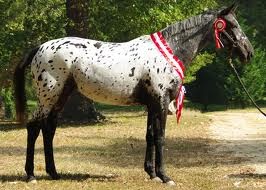
 Knabstrupper sport horse(credit)

 In 2002, Mike a Caroline Athey became interested in the breed, so arrangements were made for a Knabstrupper stallion, Apollon, to be bred with three Appaloosa mares, approved by the Knabstrupper's breed society. Later, Knabstrupper mares and stallions were imported to America. Today, the breed is increasing in popularity.

Breed Description and Uses
 The Knabstrupper can come in three different body types: Sport, Baroque, and Pony. The Sport type was bred specifically to compete in sports, such as show jumping, dressage, and eventing, by crossing the Knabstrupper with various wamrbloods. The Baroque horse is shorter and stockier than the first, and is what the original carriage and war Knabstruppers looked like. The last is a small, spotted pony version of the Baroque suitable for children. Despite their differences, most Knabstruppers have several things in common, such as their kind temperament, trainability, strength, and stamina.

 All Knabstruppers have spotted patterns similar to that of an Appaloosa, with leopard being the most common.

Friday, August 2, 2013

The Palouse Horse

 In the early nineteenth century, Danes began to selectively breed horses with small, round spots, a breed later known as the Knabstrupper. Other such horses were bred in Austria, too. It is likely that explorers of the New World took the forebears these special horses with them on their journey.  However, many escaped or were stolen by Native American tribes, who loved the horses spotted patterns. 

 The Nez Perce people, who lived in the area now called Oregon and Washington, were proficient horsemen, and adeptly bred their horses, only bringing out the desirable traits. Years of selective breeding produced a rugged horse with robust hooves, strong legs, sparse tails that would not catch on any brush while the horse rambled about the wilderness, and camouflage spots that were coveted by every tribe. Over the years, the number of spotted horses raised dramatically.
This Appaloosa has the coat pattern known as leopard.
The German word for this coat translates as "spotted tiger."
credit

 Then, in the early 1800s, pioneers trekking west noticed the spotted horses, referring to them as "Palouse" horses, after a river that ran through the area. In 1877, the U.S. Cavalry killed the Palouse horses after the Nez Perce had waged war on the U.S. Government for taking their land away.  Some of the horses escaped, and settlers took them, breeding them with heavy Spanish horses to produce a horse that could work on farms and ranches.

 Later, an "a" was added to the beginning of the name and the spelling changed a little(pronunciation remained the same). By 1938, the Appaloosa Horse Club was founded, and members endeavored to refine to the breed, which was then a stocky draft-type, with Arabian and Quarter Horse blood. Since then, their numbers have increased.


This Appaloosa, named Go Skippa Rock, has a dusting of white,
as if snow had lightly fallen on him. This pattern is known as snowflake.
A third coat pattern(above) is called blanket.
It may cover only the hindquarters, like the one above,
or it may stretch all the way the withers.
Some blankets, called snowcaps, do not have spots on them.
credit
Marble coats, like the one above, is really no different than
a regular roan coat. credit
 Two basic types of Appaloosas exist: a bulky type, which most resembles the draft one used for farm work, and a muscular one with upright carriage.  Appaloosas are usually 14.2 to 16 hands high, and have a small, well-formed face and pointed ears(most like from the Arabian blood), with white sclera rings around the eye. They have sloped shoulders and are deep-chested. Another attribute is the mottled skin around the muzzle.
This foal is almost leopard colored, except for the fact that
that he has some brown on the knees, hocks, and face.
Some consider this to be a different color, known as near-leopard.
(click here if you are interested in seeing more coats)
 Of course, their trademark is their coat pattern. Several exist, including the snowflake, which is any solid color with a light powdering of white; blanket, which is a solid color that has a patch of white on the hindquarters, sometimes with colored spots inside of it; and leopard, a pattern with spots all over the body. Another pattern is a roan Appaloosa, with dark stripes, known as varnish, along the cheekbones.


 Appaloosas can be used in many disciplines, including combined driving, dressage, show jumping, endurance racing, and any western event. Also, on the West Coast, Appaloosas pound rapidly down racetracks, just like Thoroughbreds commonly do.

 Check out the breed's official webpage! Appaloosa Horse Club