Showing posts with label racehorses. Show all posts

Tuesday, June 10, 2014

Interview: Jodi

 I recently found Jodi's blog, Racing to Ride, and as I enjoy horse racing, I decided to interview her on job working with racehorses. Enjoy!


What are your responsibilities at the racing stable/track?

 I kind of do it all, though lately I haven't been doing much in the cleaning stalls category. Mostly, I tack horses, watch them train, ride the pony-horse, and occasionally take one of the race horses to the track. Leg (wrapping, mudding, sweating, icing, etc.) and body (massaging, stretching, and red lighting) work is also a big part. There is a lot more to the business than just taking care of the horses, so I also handle the billing and keeping Ty, my fiancé, and the owners in sync. I also help with picking horses to claim or buy.

What is a typical work day like?
I hate to admit this, but I'm a bit of a slacker when it comes to getting up in the mornings. I usually get up at about 5:45, which is pretty late for the track. My fiancé gets up a lot earlier. After arriving at the barn, I usually tack the first horse, watch it go, then go back and repeat. Or I take the pony with them. Every day is a little different. It depends on how many horses we need to track or if we are working (breezing) any that day. Watching the horses track and work is very important to me so I spend a large part of the morning doing that.

The races are in the afternoons and we usually only run about 1-3 horses a week. If we have one in, about two and a half to three hours is spent getting them ready. When we don't have a horse in, I usually spend the afternoons riding my dressage horses, resting, or watching the races.

The evenings are pretty easy. We feed and pick stalls mostly. This is usually when we do leg work too. Then go out to dinner with owners sometimes.

Could you tell me a little about some of the horses you are currently working with?
Oh, I could write a book on all of them. I will try to keep it short and down to just a few though.
Kama Su (Johnny)- He is kind of a head case, but I love him. He's beautiful! We claimed him out of California. He didn't have much of a foundation so we went back to the basics with him. Johnny is really starting to come around and I'm hoping that taking our time with him will pay off. My favorite part about him is that when he is coming back to the barn from the track, he perks up his ears and walks faster when he sees me. The jockey we put on him always tells Johnny "There's your girlfriend, bud!" as they start walking towards me. If he gets worked up in his stall, I can usually go pet him and get him calmed down. He doesn't really do that for anyone else.

Princessofthering (Princess)- I bought her off of a friend for $200. He was threatening to sell her as a recipient mare and I told him I would take her. She only had ten starts and had already been through three barns. I figured with a little consistency she could have some success on the track. She won a race with a $12,500 dollar purse about sixty days after I bought her. She is good to be around, smart, classy, and is starting to get very confident. I'm extremely proud of her!
Woody

Woodpulp (Woody)- He is a bit of a hard luck horse. If some weird thing can happen to him, it does. Woody is the sweetest thing in the world though. No matter what happens, he is always a happy horse and loves people. He has a huge stride and is a gorgeous mover. I'd really like to find him a home in a dressage barn when he retires (if we still have him). I hope he can still have more success on the track before that though. (Editor adds: Woodpulp is by Lucky Pulpit, California Chrome's sire.)

Pentagram (Berni)- He is the type of horse that you notice. He's plain bay, but is very pretty with a commanding presence. We've had some set backs with him, but I think he is starting to get lined out now. I'm looking forward to running him again.
Chopperette

Chopperette (Harley)- She was disgustingly skinny when we got her just over a year ago. So, of course I've spoiled her and now she thinks she's the queen of the barn. She's a little pushy and moody, but not in a mean way. I like a horse with a little bit of spunk anyway.

How and when did you first become interested in working with racehorses?
I've been infatuated with racehorses my entire life. My Grandpa was a trainer at one time. My dad took me to the races some when I was a kid.  I've always been interested in them, but never became actually involved with the racehorses until I met my fiancé in 2007. I didn't start working at the track until 2009.
Jodi's grandfather.

How did you get into the racing industry and working with racehorses?
Through my fiancé. I was working full time and riding dressage horses, which didn't leave much free time, but I spent every moment I could at the track. I always hated it when the season would end. My fiance would leave in the Fall to go to another track. I hated getting left behind. I missed him and racing. In 2009, the track at home didn't run. I had gotten hurt and couldn't ride anyway, so I quit my job and went to Arapaho Park in Denver with my fiancé. I gave up a lot to do this, but I don't regret it.
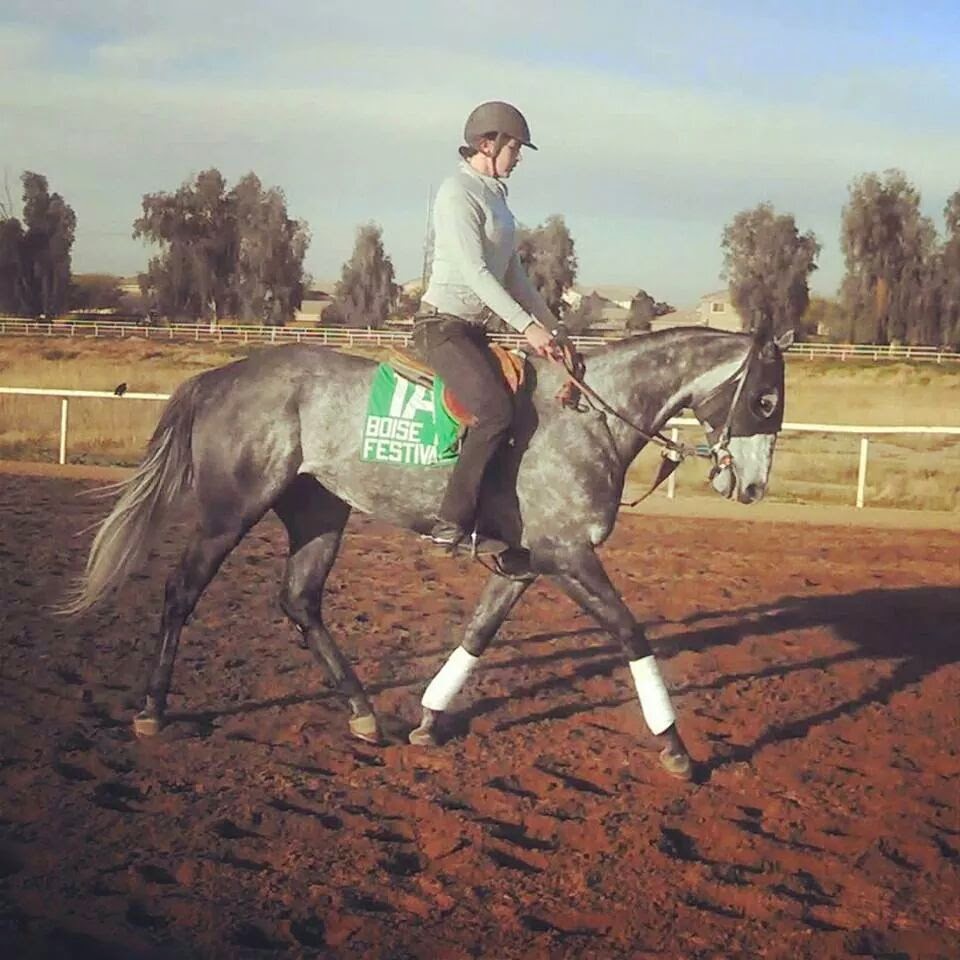
Justcallheraggie, one of the horses Jodi works with.

Who is you favorite racehorse you have ever worked with?
We've been lucky and had some pretty nice horses. It's hard to pick just one favorite, but I would have to say Scherzi. She won seven races and made just over $100,000 in the time we had her. That included a stakes win and some stakes placings. The owner had claimed her for $5,000.

Scherzi is probably the smartest horse I've ever worked with. She was little, about 15 hands, but had a heart of gold. She always tried hard. She was one of the most athletic horses I worked with! Scherzi was professional and classy, but also seemed to have a sense of humor.  She stomped in the paddock and post parade like a little Zenyatta.
Scherzi

Her half sister, So Many Ways, ended up being an extremely nice horse, so Scherzi is now a brood mare. She had her first foal, by Scat Daddy, this year.

What is your favorite part about working with racehorses?
I love the horses in general. Their different personalities and the challenges each one presents. I am constantly learning something new from them. They put so much trust into us, that I want to keep learning from them to be better for them. This is the case with any type of horse, but I think it's more extreme with racehorses. You have to pay attention to every little detail about them, physical and mental. This is a very high risk sport and if you aren't attentive enough to the horses, the results can be catastrophic. I love having to know each one so well. It's not necessarily the win that matters as much, but all of the work and pride put into getting them there.

What are the biggest challenges in working with racehorses?
Everything! Just kidding. Kind of. They are on a lot of high energy feed. They have to be able to focus and behave, no matter how good they are feeling, or it can become dangerous. Teaching them to use that energy in the right way can be difficult. You have to be very disciplined and draw the line.
It's also hard when a horse gets claimed or taken away for whatever reason. We are very hands on and spend a lot of time with these horses. It's hard to not get too attached. Mostly, it kills me if one gets hurt. Even if it was something that was out of my control, I feel responsible.
Beefeheart
Another of Beefeheart, Jodi's OTTB.

Since you work with racehorses, I was wondering---did you get your OTTB directly from the track(maybe you worked with him when he was a racing) or did you get him through an adoption center?
My fiancé trained my OTTB, Beefheart. He hadn't been running well, the owners wanted to sell him. No one really wanted him, so Ty ended up buying him for me. Gunner, our pony-horse that I also ride dressage,  was Ty's first racehorse. I have to stay away from the adoption centers because I have a tendency to want to rescue them all. I can only afford so many horses.
Gunner, another of her OTTBs.
 Gunner at his first show.

Because you are familiar with racehorses, do you have any advice for anyone working with or riding OTTBs?
I think people need to understand how the horse is trained on the track to be able to retrain correctly. Educate yourself about their training, so you understand why they do what they do and don't get frustrated. Be patient. The worst thing you can do is get mad and start muscling them around. Understanding them is the key to an OTTBs success. Most of what you ask will be new. They are going to depend on you for confidence and guidance, make sure you are able to give that to them before ever getting on.

What are some of the challenges in training your OTTB for dressage?
Probably redeveloping their muscles for dressage. I don't think many people think about this, but going slow and carrying their weight on their hind end is going to be a lot harder for them than going fast. It helps if they're already fit, but it still involves them having to use muscle groups differently. They have to learn to relax to be able to do this. They have to learn to bend through their body and stay loose over their topline. This involves the rider being able to control the rhythm of the horse. To do this, the horse has to be able to balance. So much goes into building the correct muscles that it includes most of the other challenges a rider will face with their OTTBs. It takes a lot of time and patience
Silk Indian

Anything else?
I think that's about it. Horseracing definitely keeps life interesting. We work seven days a week, including holidays. It's nearly impossible to take a vacation. It's not an easy life, but it's worth it to me and I love it!

Thank you Jodi! Go check out her blog if you don't know her yet!

Tuesday, April 8, 2014

California Chrome and Kentucky Derby 2014

 This year's Kentucky Derby is fast approaching, and will occur on May 3, the first Saturday in May. As the date draws near, racing fans begin to wonder whether this will be the year we will have the first Triple Crown winner since Affirmed in 1978. With the recent Santa Anita Derby, a favorite had already been picked for the Derby: California Chrome.

 California Chrome is a chestnut colt sired by the 2001 Lucky Pulpit, a sprinter that won in mostly short races. His 2006 dam, Love the Chase, has names like Northern Dancer and Mr. Prospector in her pedigree, and other horses that suggest she may have passed stamina onto her son. For those of you who are interested, here is his pedigree.
California Chrome credit

 California Chrome has only raced ten times, but placed first in six of those races. He broke his maiden in only his second race before running a few stakes races. In the William L. Proctor Memorial Stakes, he placed fifth. He next won the Graduation Stakes at Del Mar, placing sixth in his next two races, and ending his season with a victory at the King Glorious Stakes. This year, he has won all three of his races: the California Cup Derby, the San Felipe Stakes, and most recently, the Santa Anita Derby.

The second betting favorite is Vicar's in Trouble, whose sire is the 2005 Into Mischief, a stallion who did well as a two-year-old but was injured as a three-year-old. Nevertheless, he is becoming a successful sire. Vibrant is his 2002 dam. She raced a few times, winning a short sprints. His pedigree also includes stop the Music, Affirmed, Bold Ruler, Mr. Prospector, and Secretariat.

 Vicar's in Trouble has raced five times, winning three of then and placing third in the other two. He too broke his maiden on his second race, going on to win the LeComte Stakes in his first race this year. He came third in the Risen Star Stakes, but won his most recent race, the Louisiana Derby.

 Other Kentucky Derby prospects include Wicked Strong, Samraat, Constitution, Hoppertunity, Intense Holiday, Wild Cat Red, We Miss Artie, Chitu, Midnight Hawk, Ring Weekend, and more. I'm excited to see how this year's Derby turns out.

 Also, in other news, I got a dressage book for my birthday today, so once I am done with it, I will review it on my blog.

Thursday, March 13, 2014

Thoroughbred

History
 The Thoroughbred was originally developed as a racehorse in England in the 17th century. Oriental stallions, the most influential being Darley Arabians, Godolphin Barbs, and Byerly Turks, were bred with native English mares. One of the most important early Thoroughbred stallions was Eclipse, from the Darley Arabian line. As an undefeated early racehorse, he had a huge influence on the Thoroughbreds of today. In fact, about 90% of Thoroughbreds can trace their line back to Eclipse and the Darley Arabian.

By the 18th century, horse racing had become very popular, and was considered the "sport of kings" because it was watched mostly by royalty. Thoroughbreds were selectively bred both as flat racers and steeplechasers in the England. Originally, races were much longer than they are today---about four miles---but this later changed to the shorter, mile long races that are now seen. With this change came an increased need for faster, younger horses rather than those better suited for longer distances.
Thoroughbreds, particularly the ex-racers, are commonly used in eventing.
credit

 The first Thoroughbred arrived in America in 1730, and before long horse racing became popular in the United States as well. Today, Kentucky is the hub of Thoroughbred breeding, though California and New York breed a lot of them as well.

Breed Description and Uses
 Thoroughbreds are a tall breed, averaging around 16 hands high or taller, with long legs that give them ground-covering strides. They have sloping shoulders and prominent withers. Their neck is long and thin and their face has a straight profile. All in all, centuries of selective breeding has made the Thoroughbred into a runner. Chestnut, black, grey, and various shades of bay are the colors Thoroughbreds come in.

 Other than racing, Thoroughbreds are used for show jumping, dressage, and eventing, the latter of which is common in OTTBs.

Tuesday, March 11, 2014

Zenyatta Part 2(2009-2010)

  After a successful season in which she went undefeated, Zenyatta was awarded the Eclipse Award for being the top older female of 2008, and was voted as the runner-up for the American Horse of the Year award.

 On May 23, 2009, Zenyatta began another season of racing with the Milady Handicap, a race she had entered the previous year, at Hollywood Park. Because she was fast, she carried 126 pounds. She and a horse from her own stable, Life is Sweet, battled down the homestretch, with Zenyatta coming first by 1 3/4 lengths. Next, she entered the Vanity Handicap on June 27. Despite her burden of 129 pounds, over ten pounds more than her opponents, Zenyatta came first by 2 1/2 lengths.

 After her two handicap races, Zenyatta moved on to race in a stakes race, the Clement L. Hirsch Stakes, on August 9. With just a furlong left, she was four lengths behind the first place horse, Anabaa's Creation. She used one last burst of energy to catch up with the other horse, winning by only head.

 Next, she entered the Lady's Secret Stakes for the second yeard in a row, on October 10. After she defeated every other horse on the track, her trainer decided to enter the horse in the Breeders' Cup Classic on November 7. She would be racing against many champion racehorses. During the race, Zenyatta galloped down the racetrack, defeating champions such as 2009 Kentucky Derby winner Mine That Bird,  Rip van Winkle, 2009 Belmont Stakes winner Summer Bird, and Champion Older Male Gio Ponti. She came in first place over Gio Ponti by a length, making her the first female to win the Breeders' Cup Classic.

 At the beginning of 2010, she was awarded the Eclipse Award for top Older Female of 2009 and was runner-up to Rachel Alexandra for Horse of the Year honor. Though everyone was told that she would be retiring, Zenyatta continued her career through the season of 2010, beginning with a victory at the Santa Margarita Invitational at Santa Anita on March 13. She had weaved through the pack of horses, passing them mid-way through the homestretch.

 Next, on April 9, she entered the Apple Blossom Invitational, where it was planned she would race against the champion Rachel Alexandra. However, Alexandra didn't enter because of a recent loss, and Zenyatta went on to defeat the other horses.

 On June 13, Zenyatta won her 17th consecutive race, the Vanity Handicap, with 129 pounds on her back, breaking both Cigar's and Citation's records of consecutive races won. Next, she won the Clement L. Hirsch  Stakes on August 7 and the Lady's Secret Stakes on October 2. At that point, she had gone undefeated in all her nineteen races. However, that ended when she entered the Breeders' Cup Classic on November 6. She fell far behind the leader, Blame, demonstrating the Thoroughbred heart when she ran her fastest to catch up, losing only by a head.

 That year, she once again earned the Eclipse Award for top Older Female, also earning the Horse of the Year award for 2010 and the Secretariat Vox Populi Award. She also is noted as the first female to win the Vanity Handicap, the Clement L. Hirsch Stakes, and the Lady's Secret Stakes for three years in a row. She is considered one of the greatest female racehorses.

Monday, March 10, 2014

Zenyatta, Part 1(2007-2008)

 On April 1st, 2004, a beautiful dark bay filly, born out of Vertigineux with the sire Steet Cry, was born on Don Robinson's Winter Quarter Farm in Kentucky. As a yearling, she was sold to Jerry and Ann Moss for $60,000. They named her Zenyatta, after an album by The Police. Her trainer was John Shirreffs.

 Zenyatta began her racing career much later than most horses, racing her first race toward the end of her three-year-old season. Her first race was the Maiden Special Weight at Hollywood Park, a short 6 1/2 furlongs race, which took place on November 22nd of 2007. The tall, 17.2 hand three-year-old, ridden by David Flores, galloped down the stretch to win by three lengths. On December 15, the two won the 1 1/6 mile long Allowance race by 3 1/2 lengths.

 On January 13, 2008, Zenyatta ran her first graded stakes race, the 1 1/6 mile Grade 2 El Enico Stakes at Santa Anita. She won in the record time of 1:40.61. Next, on April 5, she entered the Grade 1 Apple Blossoms Handicap, a race open for mares four years old and older. Zenyatta was ridden by Mike Smith in this race, defeating older champions with a lead of 4 1/2 lengths. Afterward, she returned to Hollywood Park to win the Grade 2 Milady Handicap on May 31 and the Grade 1 Vanity Handicap on July 5. Then, she won the Grade 2 Clement L. Hirsch Handicap on August 2, setting a track record of 1:41.48.

 Next, on September 27, entered the Grade 1 Lady's Secret Stakes at Santa Anita, where she incredibly ran each quarter mile faster than the previous one, setting a 1 1/6 mile stake record of 1:40.30. She then became a favorite for the Breeders' Cup Ladies' Classic.
Zenyatta in the 2008 Breeders' Cup Ladies Classic credit

 Her last race of that season, the Breeders' Cup Ladies' Classic on October 24, began with Zenyatta in last place. Then, she came from behind and passed every horse on the track to finsish in first place. At the time, Zenyatta had gone undefeated in the first nine races of her racing career.

Thursday, February 27, 2014

Mine That Bird

 On May 10, 2006, a small bay colt was born in Kentucky out of Mining My Own, with the Birdstone being the sire. As a yearling, Mine That Bird was sold to a Canadian horse trainer, David Cotey, for $9,500 and put into training in Canada. He had a nasty temperament at first, so they gelded him not long after he went into training.

 Mine That Bird began his racing career in Canada, winning four of six races, including the Silver Deputy Stakes, the Swynford Stakes, and the Grey Stakes, with jockey Constant Montpellier riding the gelding for the first two races and Chantal Sutherland aboard for the last four. By the end of his two-year-old season, he had become Cananda's Champion Two-year-old Male Horse of 2008.

 After his successful first racing season, Mine That Bird was sold for $400,000 to a ranch in New Mexico and was put under the trainer Bennie "Chip" Woolley with the jockey Calvin Borel. He arrived just in time for the 2008 Breeders' Cup Juvenile, but finished last among twelve starters.

 He didn't race again until 2009, during his three-year-old season. The season didn't begin with a any wins, starting with Mine That Bird finishing second in the Borderland Derby on February 28, then fourth in the Sunland Derby on March 29. Despite the losses, Mine That Bird qualified for the Kentucky Derby, which would be his first race that year outside of New Mexico. He arrived at the as an underdog, his odds being 50-1.

Mine That Bird in the Kentucky Derby.
credit
 The night before the big race, rain poured down, leaving the track muddy and sloppy. Mine That Bird had trouble at the starting gate that race, leaving him eight lengths behind everyone else. By the time the rest of the pack was travelling down the backstretch, it seemed impossible for Mine That Bird to catch up. Calvin Borel urged the gelding onward, travelling along the inside rail to save time and distance. When Mine That Bird caught up with the rest of the pack, he zoomed passed them from the inside, taking the lead near the homestretch. Remarkably, he won by six lengths against horses whose odds were much better than his.

 After his amazing performance in Kentucky, which many people considered a fluke, Mine That Bird entered the Preakness Stakes under the jockey Mike Smith since Calvin would be riding Rachel Alexandra. Mine That Bird again started out slow and came from behind to pass the rest of the pack, but he was unable to catch up with Rachel Alexandra. He finished second behind her by only a length.

 Next, he entered the Belmont Stakes and was once again ridden by Calvin Borel. He came from behind, catching up with Dunkirk and Charitable Man near the end, but ended up third to Summer Bird and Dunkirk.

 He then came third in the West Virginia Derby and ninth in the Breeders' Cup Classic, ending his career. Afterward, he was nominated as New Mexico's 2009 Horse of the Year.

Tuesday, October 15, 2013

Interview: Lynn Reardon

 Last week, I was able to interview Lynn Reardon, who runs the LOPE(LoneStar Outreach to Place Ex-Racers) in Texas. She re-homes ex-racehorses, something I am interested in doing. It was a really fun interview and I thought you guys would enjoy it.

Midway, one of the horses Lynn rehomed.
credit
Do you need any special education or a license to rescue horses? No, that is not a requirement. I had owned horses before and had some very basic understanding of horse care needs -- which was helpful.

How did you first get interested in rescuing horses? How did you get started? I wrote a book (Beyond the Homestretch) about how I began my work -- it was a bestseller in Austin and Dallas, plus became the #1 horse book on Amazon for a short period. I actually never got interested in "rescuing" horses -- instead I had fallen in love with ex-racehorses and wanted to work with them very much. I wasn't a professional trainer and didn't have the usual credentials to become a trainer. My career had been in accounting and administrative management for nonprofit organizations -- horses were a hobby. I took lessons at a polo barn -- and nearly all of the horses were ex-racehorses. When I realized that ex-racehorses often need help transitioning to new lives after racing -- and that Texas didn't have a racehorse charity to do that -- boom, I had the idea to start LOPE. It was a way to combine my previous nonprofit experience with helping ex-racehorses :) We actually see ourselves as an employment agency for at-risk equine youth rather than a fireman kind of rescue place. 

What are your primary responsibilities around the rescue? At our ranch, I supervise the care of all the horses (feeding, vet care, farrier, etc). I also do the riding and training at our farm (though we also send some of our horses to professional trainers before being adopted). I am also responsible for fundraising, event management, updating the website and social media pages -- and writing for our blog.

How do you find the horses and how much do you usually buy them for? We take donations of horses directly from the racing industry -- which means that race owners, trainers and breeders donate their horses to LOPE that aren't racing anymore. We don't usually buy horses.

How do you decide which horses to rescue? We take horses on a first come, first serve basis from the industry. We do prefer that the horses have raced within the last year and that they be able to do another job with retraining and rehab.
Lynn on Mystery Blessing. credit
How much work does it take to train and rehabilitate the horses before you set them up for adoption? Each horse is an individual, so the answer to this question varies depending on the horse. Typically, we like to give the horses a month or so off from work (like a mini-vacation) before we start retraining them. The retraining might take just a few rides or a couple months. Rehabilitation also varies, depending on the type of injury. We have taken in horses with simple mild body soreness as well as horses requiring surgery to remove bone chips -- so the range is pretty broad :)

What sort of training exercises do you do with them to get them ready for being ridden off the track and prepare them for future careers(pleasure, jumping, etc)? We like the horsemanship school of Tom Dorrance and Ray Hunt. These two master horsemen are now deceased, but there are several excellent clinicians who studied with them -- such as Buck Brannaman, Peter Campbell and Tom Curtin. If you would like to get a better sense of this horsemanship, you might want to check out the documentary called "Buck" -- it is about Buck Brannaman and you might really enjoy it. The movie won the Audience Award at Sundance Film Festival and made the long list for an Oscar nomination.

But back to your question -- we like to help the horses with the basic foundation training (kind of like kindergarten for horses). We do ground work exercises, a gentle re-starting under saddle (so they learn that being ridden doesn't mean racing anymore) and overall building their confidence levels. If we help the horses get a good foundation in the basics, we think that will help them no matter what career (jumping, trail riding, etc) they go into later.

What is your favorite part about rescuing horses? I really love working with the horses and riding them! It is so much fun to help a horse learn new job skills that help keep him safe in the future :)

What is your advice to someone wanting to start a career in rescuing horses?(I realize that it's more of passion than something you do to make money) First, I would say it is important to narrow your goal. Do you want to rescue horses from neglect situations? Do you want to transition racehorses to new careers? Do you want to work with senior citizen horses? Or PMU foals? All of those things (and more) are considered forms of horse rescue -- but are all very different types of work. It's kind of fire fighting. Do you want to be the firefighter who pulls people from burning buildings and leaves them safely on the curb? Or do you want to be the nonprofit shelter that takes the people in while their house is being rebuilt? Or do you want to be the person who set ups smoke detectors in homes -- so that a fire wouldn't happen at all?

Also, I worked in the nonprofit world for years before I started a horse adoption charity. There is no reason why someone who runs a horse rescue shouldn't be paid -- it helps keep the organization stable to have a paid person running it and also is reassuring to funders to know that the charity is well-managed. I am paid for my work -- it's a very small salary, but my charity's board of directors insist that I take some payment for my work -- because they think it is important to value the efforts of the executive director position.

What do you do if a horse doesn't get adopted? That has never happened :) Once a horse comes to LOPE, he or she can stay as long as necessary to find the right home. One horse (Storm, who is in my book) was with us for almost two years -- but eventually found the perfect home for him.

Do you have a favorite horse that you have rescued? In my book, I talk about a beautiful stallion named Tawakoni. He was the son of a famous winner of the Kentucky Derby (Grindstone). I had never worked with a stallion before -- and when I asked horse neighbors for advice, they all thought I was crazy to have a stallion on our place (because in their biased world view, all stallions were dangerous). But Tawakoni was very gentle and well-mannered. He was adopted by a petite woman who owned a beautiful breeding facility for show horses. She worked with her stallions easily and had no fear of them. She and Tawakoni taught me how important it is to not accept the "conventional wisdom" on face value -- but instead to keep an active, inquisitive mind to learn the truth about horses.

Is there anything else you would like to add? No, you asked excellent questions -- thank you for that!

Also, do you allow visitors? Yes, we do allow visitors by appointment :)

Sunday, October 13, 2013

Book Review: Beyond the Homestretch, by Lynn Reardon

 Quite recently, I purchased a Beyond the Homestretch, by Lynn Reardon. Lynn founded LOPE(LoneStar Outreach to Place Ex-Racers), a Texan adoption center focusing on finding homes for ex-racehorses. It was an excellent read!
Click here to check it out

Summary
 Beyond the Homestretch talks about how Lynn quit her office job in Washington DC and moved out to Austin, Texas area. She became interested in Thoroughbreds and decided she wanted to rescue them. At first, she started out by just listing adds on her website for local trainers and owners, but one day, she  bought a 26 acre ranch and began taking horses to her ranch as well. The book is full of success stories, ranging from those of a docile filly, injured geldings, a stallion, and many more horses–all experiences of her own.

 I love her writing style, too. her descriptions are vivid, often involving humorous descriptions about certain situations.  I would recommend this book to any Thoroughbred lover, or people who are interested ex-racehorse success stories. Beyond the Homestretch is definitely high up on my favorites list!


Saturday, September 21, 2013

Secretariat Sketch

Secretariat was one of the greatest Thoroughbreds to ever set foot on the racetrack.
Even people unfamiliar with horse racing know of his achievements. He is most known
for winning each Triple Crown race in record time and zooming to a 31 length finish in
the Belmont Stakes. Today, this legendary horse is considered to be one of the greatest
racehorses to ever live, the other being Man o' War.

Thursday, June 6, 2013

Belmont Stakes 2013, Part 2

The next seven horses are listed below:
Revolutionary(credit)
Revolutionary was sired byWar Pass. He broke his maiden
on Aqueduct's inner track, then won several stake races back-to-back,
including the Grade 3 Withers and the Grade 2 Louisiana Derby.
Out of seven starts, he has never placed worse than third.
Golden Soul(credit)
Golden Soul is out of Hollywood Gold, the
daughter of Mr. Prospector, the half-brother of Quintons Gold Rush.
His sire is Perfect Soul. One of his best finishes this year was when he ran second 11 1/2 lengths behind Oxbow
in the LeComte. He also finished third behind Orb in the Kentucky Derby.

Unlimited Budget(credit)
Unlimited Budget was sired by Street Sense. Her dam is Unlimited
Pleasure. As a two-year-old, she was purchased for $475,000.
In November of last year, she won her first start by 9 1/2 lengths,
then won three consecutive stake races:Grade 2 Demoiselle last year,
and the Grade 3 Rachel Alexandria and the Grade 2 Fair Ground Oaks
this year. Her first defeat came when her stablemate Princess of Sylmar and
two-year-old filly champion Beholder beat he in the Grade 1 Kentucky Oaks.
She will be the 23rd filly to compete in the Belmont. Only three fillies have won:
Ruthless in 1867, Tanya in 1905, and Rags to Riches in 2007.

Midnight Taboo(credit)
Midnight Taboo was sired by Langfuhr. His dam, Hot Red, was sired by
Thunder Gulch, who won the 1995 Belmont. In 2011, he was bought for $240,000
at the Keeneland September Yearling Sale. He raced only once as a two-year-old,
coming second at Saratoga, and broke his maiden this year in a mile long race at Aqueduct,
defeating older, more experienced horses. Next he placed second to Irsaal, a
well-regarded horse.
Palace Malice(credit)
Palace Malice is the son of two-time Horse of
the Year Curlin and the dam Palace Rumor. His only victory
was in his maiden race at Saratoga. This year,  out of five starts
he has two seconds, one at Gulfstream and the other in the
Grade 1 Blue Grass, and one third in Grade 2 Risen Star.


Vyjack(credit)
Vyjack was sired by Into Mischief, and his dam is Life Happened.
He won the first four starts of his career, which were all at
Aqueduct, including the Grade 2 Jerome and the
Grade 3 Gotham. He placed 18th in the Kentucky Derby and hasn't raced
since. Also, he is attempting to be the third gelding to
win the Belmont, the others being Creme Fraiche in
1985 and Ruler on Ice in 2011. His name comes from
his owner David Wilkenfield's parents: Vivienne
and Jack.

Will Take Charge(credit)
Will Take Charge was sired by Unbridled's Song, winner of
the 1995 Breeders' Cup Juvenile and the 1996 Florida Derby
and Wood Memorial. His dam is Take Charge Lady. In
his lifetime, he has only won two stake races: The Smarty Jones
and the Rebel, and came seventh in the Kentucky Derby an the
Preakness. As a yearling, he was purchased for $425,000.

Belmont Stakes 2013, Part 1


A few weeks ago, Oxbow upset Orb in an exciting race at Pimlico. Though we will not have Triple Crown winner this year, the Belmont Stakes remains the exciting Test of Champions, which will show who the better horse is. Both Oxbow and Orb will be entering, but they will have to get through a lot of great horses if either of them want the Triple Crown's third jewel. Maybe we will have another Triple Crown near-miss, like I'll Have Another last year. You will see some horses returning to take revenge for their loss in the Derby. Below are the horses listed to enter:
Orb(credit)
Orb, who's paternal grandsire is A.P. Indy, 1992 Belmont winner, is
attempting to become the first horse since Thunder Gulch in 1995
to win a Kentucky Derby-Belmont double. If he succeeds, he will
become the 12th horse to do so. Orb was beaten by a total of 30
lengths in his first three races, but improved from there. By the time
he won the Derby, his winning streak was at five. In the Preakness,
he got boxed in and came fourth.(click here for footage)
Oxbow(credit)
Oxbow was sired by Awesome Again, winner of the 1998
Breeders' Cup Classic. His dam, Tizamazing, is the unraced
sister of Tiznow,  2000's Horse of the Year and two-time winner
of the Breeeders' Cup Classic. As a yearling, he was bought
for $250,000. With 11 starts, he is the most experience
three-year-old heading into the Belmont on Saturday.


Frac Daddy(credit)
In 2011, Frac Daddy was purchased by Magic City
 Thoroughbred Partners for $50,000 at the Keeneland
September Yearling Sale. His sire is Scat Daddy,
and his dam Skipper's Mate. He is known for
placing second in the Grade 1 Arkansas Derby and
the Grade 2 Kentucky Jockey Club. So far, he has earned
$288,116.
Incognito(credit)
Incognito was sired by A.P. Indy, one of Seattle Slew's successful
sons who won the 1992 Belmont, Breeders' Cup Classic and Horse of
the Year Honors. His dam is Octave, by Unbridled's Song.
He finished fifth at Aqueduct on December 15, his only
race that year. On March 16 this year, he broke his maiden,
running a 1:37.62 mile on Aqueduct's inner track. He won his
first allowance by a nose on April 13. Then he came
third place in the Grade 2 Peter Pan, finishing less than
half a length behind the second placer.
Overanalyze(credit)
In 2011, Overanalyze was purchased for $380,000 in the Keeneland September Yearling Sale. He is by Dixie Union, and his dam is Unacloud. Just after breaking his maiden as a 3-5 favorite at Saratoga on August 9, he jumped to graded stakes races, where he placed fourth behind his stablemate, Shanghai Bobby in the Grade 2 Hopeful. Next he won the Grade 2 Futurity and placed third in the Grade 3 Iroquois before closing his season with a victory of a nose over Normandy Invasion in the Grade 2 Remsen. He qualified for the Kentucky Derby by winning the Grade 1 Arkansas Derby by 2 3/4 lengths. He placed 11th in the Kentucky Derby.
Freedom Child(credit)
Freedom Child's sire is Malibu Moon, who is by the
great A.P. Indy, and his dam is Bandstand, by Deputy Minister.
He raced only twice as a two-year-old, breaking his maiden
on March 10th at Gulfstream Park. In the Grade 2 Peter Pan,
he lead wire to wire in a 13 1/4 length victory.
Giant Finish(credit)
Giant Finish is by Frost Giant, the 2008 Grade 1 Suburban Handicap winner, and he is out of Apocalyptic. After placing in the John Battaglia Memorial, he finished third in the Grade 3 Spiral. Then he came tenth in the Kentucky Derby. His owner's goal for him is that he becomes the first New York bred to win the Belmont since Forester in 1882.


Wednesday, May 29, 2013

Affirmed: Four-Year-Old Season

 After spending the winter in California, Affirmed returned to the track for his final season. He had a new jockey: Laffit Pincay, Jr. He began his season with an almost effortless ten length victory in the Charles H. Strub Stakes. Next he won the Santa Anita Handicap with 128 pounds on his back, running the mile and one quarter in the record time of 1:58 3/5, as well as defeating the son of champion racehorse Exclusive Native by four and a half lengths.

 That May, he went to Hollywood Park for the California Stakes. Many worried about the burdensome weight of 130 pounds that he was required to carry, but it didn't affect his performance; he won by five lengths.

 Because of his victory, he was then required to carry 132 pounds in the Hollywood Gold Cup. In that race, he met the Italian champion Sirlad, who forced Affirmed to run at a tremendous pace considering his burden. Affirmed managed to hold the lead long enough to win by three-quarters of a length and to run the race in 1:58 2/5, missing the American record for that distance by only 1/5 of a second.

 Affirmed rested for two months following his victory in the Hollywood Gold Cup before going to New York to win two more races. However, trainer Laz Barrera kept him out of the Marlboro Cup since he was assigned 133 pounds, while the young champion Spectacular Bid was assigned only 126 pounds. He did race in the Jockey Club Gold Cup, though. Each horse was weighted according to its age.
Affirmed won the Jockey Club Gold Cup after battle
for first place with several different horses, including
Spectacular Bid.(credit)

 The race was incredible! All throughout, many horses moved forward to challenged him for first place, including Coastal, the 1979 Belmont Stakes winner, and Spectacular Bid, who challenged him four times. Affirmed won in the end, but Spectacular Bid was far from disgraced. Few horses can repeatedly challenge the leader like he did and not come close to last.

 Affirmed retired after that. He had earned a grand total of $2,393,818 in his lifetime, was made the world's Current Leading Money Winner until Spectacular Bid took his place in June 1980, and once more earned Horse of the Year honors. This time, no one questioned whether he deserved the title or not; he had proved himself many times that year.

 He first served as a stud horse in Spendthrift Farm, the Calumet, and finally Jonabell, where he passed away in January 2001.

 Some racing fans believe he failed as a stud horse since he never duplicated himself at stud. Despite those beliefs, he actually sired several noteworthy horses, including Peteski, winner of the Canadian Triple Crown; Charley Barley, the successful Canadian turf racer who earned $922,943; Bint Pasha, who became France's 1987 Champion Three-Year-Old Filly; Tibullo, who was successfully enjoyed his career in Italy; Easy to Copy, who won in Ireland; Trusted Partner, winner of Irish One Thousand Guineas; Buy the Firm, a good handicap mare; and the mare Flawlessly, who won the Eclipse Reward twice and earned over $2,000,000 while under the racing colors of Harbor View Farm, the same as her sire.

Tuesday, May 28, 2013

Affirmed: Three-Year-Old Season


 Despite an unusually long rest due to uncharacteristically rainy weather in South Carolina, Affirmed began his three-year-old season with a victory at Santa Anita, followed by a win in the San Felipe Handicap.

 After that, he defeated Balzac by eight lengths in the Santa Anita Derby. There was then only one race to win before he traveled back east: the Hollywood Derby. However, with little competition since Alydar was racing in the east coast, Affirmed began to develop bad habits. Whenever he was in the lead, he would mess around and waste time. This worried trainer Laz Barrera since the same thing had cost Affirmed the Champagne Stakes the year before. In spite of Barrera's worries, the Hollywood Derby proved no problem, and Affirmed, though slightly bored, managed to win by two lengths. After that, he went east and defeated Alydar in three classics.

Affirmed won the Kentucky Derby, with Alydar second and
Believe It third. Credit
 Then came the Kentucky Derby. Sensitive Prince took an early lead, setting a fast pace while Affirmed lingered in third place. Just as the pack entered the backstretch, Believe It took the lead, followed by Affirmed, who quickly replaced him. Alydar gave it his all, but only managed to beat Believe It for second place money. The roses belonged to Affirmed by one and a half lengths.

 In the Preakness, Alydar was more on top of things. When Affirmed took the lead at the half mile mark, Alydar followed close behind, waiting for the right moment to make his move. As soon as the two entered the homestretch, they fought hard until Affirmed won by a neck. Believe placed third for the second time.
Affirmed won the Belmont Stakes by a head in the closest
Belmont victory since 1962, when Jaipur barely defeated
Admiral's Voyage. 
 Only one more race remained, and only one horse stood between Affirmed and the Triple Crown: Alydar. Affirmed took the early lead, followed Alydar, who opted not to wait to make his move fairly late in the race like the two previous times. This time, with more than half a mile left, he began to battle his rival, doing everything in his power to steal the final Triple Crown jewel from Affirmed. Yet it was all in vain. After a long and hard-fought battle, Affirmed won by his head in the closest Belmont Stakes since 1962, when Jaipur barely defeated Admiral's Voyage.

 After a long and well-deserved rest, Affirmed once more won a race. In the Jim Dandy Stakes, he came from behind to beat Sensitive Prince, despite the slick track, carrying his winning streak to eight. However, he was unable to continue his streak to nine, as his fans had hoped. Although he came first in the Travers Stakes, he was disqualified for bumping Alydar.

 Next, he raced Seattle Slew, the previous Triple Crown winner, in the Marlboro Cup. To his fans surprise, he hardly gave Slew a challenge. Later, after a vet inspection, his owner, jockey, and trainer found that a throat infection had been the cause of his poor performance.

 In the Jockey Club Gold Cup, the two met for the second time. Affirmed failed to win once his saddle slipped after battling with Seattle Slew for an early lead. Seattle Slew, though, also failed. He was in poor condition considering the length of the two mile race, so Exceller won by a nose, becoming the first horse to defeated two Triple Crown winners, let alone in one race.

 Despite the fact that Affirmed had lost three times in a row: once because of poor health, another time due to to disqualification, and another due to tack failure, he was voted horse of the year. Lots of arguments followed that decision. Some people were outrage, thinking that Seattle Slew should have had the honors since he had defeated Affirmed---twice. Others believed that Affirmed had fair excuses for his failures. Nevertheless, Affirmed was 1978's Horse of the Year, and no argument could change that.

Friday, May 24, 2013

Affirmed: Two-Year-Old Season

 On February 24, 1975, a chestnut colt with almost perfect conformation was foaled on Harbor View Farm, Florida. His sire is Exclusive Native, winner of the Sanford Stakes and the Arlington Classics. Won't Tell You, sired by Crafty Admiral, is his dam. His pedigree on his dam's side traces back to War Admiral, 1937 Triple Crown winner, and Fighting Fox, full brother of Gallant Fox.

 Affirmed began his career with a victory in Belmont on May 24. Not wanting to waste time, trainer Laz Barrera entered the young colt in the Youthful Stakes, where he would race quality horses. Affirmed came from behind, crossing the finish line for a victory by a neck. 

 In the Great American Stakes, Affirmed met his rival: Alydar, who won their first race together. Next, Affirmed headed west to win the Hollywood Juvenile by seven lengths before returning east to win the Sanford Stakes with his new jockey, Steve Cauthen. 

 Ten days later, he met Alydar in the Hopeful Stakes, this time winning by half a length. A few weeks later, they met in the Futurity. The pair battled down the homestretch until Affirmed came out victorious by a nose. 

 Next came the Champagne Stakes. The track was sloppy, and Affirmed didn't notice that Alydar had passed him until he was too far gone, winning by one and one-quarter lengths.

Steven Cauthen explains what had happened when he said, "My horse had plenty left, but he was too busy playing games with Darby Road Creek he never saw Alydar until it was too late."

 One last time that season, the two raced, battling for victory in the Laurel Stakes and the Champion Two-Year-Old Colt title. They fought long hard down the homestretch at a tremendous speed, with the third place horse some ten lengths behind them. At last, Affirmed won by a neck, earning the title of Champion Two-Year-Old Colt.

Seattle Slew: Four-Year-Old Season

 After recovery from a respiratory infection and a near-fatal virus, Seattle Slew returned to the track in winning condition. His previous trainer, Bill Turner, had been fired, so he had a new trainer: Doug Peterson. Slew won two allowance races in Saratoga and Aqueduct, then lost by a neck in Meadowlands' Paterson Handicap.

 Then came the season's highlight: Slew and Affirmed, the 1978 Triple Crown winner, were going to race in the Marlboro Cup. Not long before the race, Slew's jockey was changed from Jean Cruguet to Angel Cordero, Jr. when Cruguet commented that Slew wasn't ready for the Marlboro Cup. Despite the change, Slew defeated Affirmed by three lengths. 
Seattle Slew running in the Marlboro Cup(credit).

 After that, Slew led from start to finish in the Woodward Stakes, defeating Exceller and It's Freezing by four lengths in track record time of 2:00. 

 Then came one of the greatest races of his career. In the Jockey Club Gold Cup, he battled Affirmed early on in the race, but failed to win, losing to Exceller by a nose. Affirmed was boxed in and ran fourth. Because of his victory, Exceller became the first and only horse to defeat two Triple Crown winners.

 In the Stuyvesent Handicap, his final race, Slew led from start to finish, winning by three and a quarter lengths. He was then retired. By then, he had won fourteen out of seventeen races and had earned $1,208,726. After he was bought for twelve million dollars as a stud horse with a fee reaching $100,000 dollars, he became an excellent stud horse with many notable offspring.

 Among his best is Swale, the 1984 Three-Year-Old Champion Colt. As a two-year-old, though, he stood in the shadow of his stablemate, Devil's Bag. Both were trained by Woody Stephens. While Devil's Bag was hailed as a wonder horse, Swale was just considered "Stephens' other horse." However, things changed when Devil's Bag retired due to a hairline fracture. Swale became the Derby's top contender. 

 The favorites were Althea and Life's Magic, two fillies trained by D. Wayne Lucas. Swale won then Derby by three and three-quarters lengths. Although he failed to win the Preakness, he almost effortlessly won the Belmont Stakes by four lengths. By the time he retired, he had won nine out of fourteen races, earning $1,583,661. Several days later, the racing world was stunned when Swale mysteriously collapsed and died after a workout. He was later buried on Claiborne Farm.

 Also among Seattle Slew's notable offspring are Slew o' Gold, a Hall of Fame colt; Landaluce, and undefeated who died of a viral infection as a two-year-old; A.P. Indy, 1992 Horse of the Year and Belmont Stakes winner; and many more. Even his daughters produced great offspring. The most famous is Cigar, two-time Horse of the Year. One of his descendants, Itsmyluckyday, raced in this year's Triple Crown. 

 During the months leading up to his death, Seattle Slew was in poor health and was beginning to recover from surgery. Then, in May 2002, twenty-five years after being named the tenth Triple Crown winner, the great champion passed away.

Wednesday, May 22, 2013

Seattle Slew: Two-Year-Old Season

 On February 15, 1974, a dark bay colt later named Seattle Slew was born on Ben Castleman's White Horse Acres. His sire was Bold Reasoning, Bold Ruler's grandson, and his dam was My Charmer, a descendant of the great mare Myrtlewood.

 Since Seattle Slew was neither the son of Northern Dancer or What a Pleasure, leading sires at the time, he was purchased for the bargain deal of $17,500 at Keeneland's Yearling Sale. Mrs. Karen Taylor, her husband Mickey, and Dr. and Mrs. Hill(the four shared ownership of Seattle Slew) named the colt in honor of their hometowns. The Taylors came from Seattle, and the Hills came from an area in Florida with lots of swamps, called slews. Hence the name, Seattle Slew.

 Seattle Slew was sent to Billy and Paula Turner's training facility in Maryland. He was clumsy, never got anything right, and swerved to the right when galloping, since his right foreleg curved to the outside. Because of that, Paula nicknamed him Baby Huey after an ungraceful cartoon character.

 However, he soon grew out of the name after several fast workouts in New York. A minor injury kept him out of the Futurity and the Cowden Stakes. Even though a horse named For the Moment dominated the juvenile division, people who had seen Slew's exercise rides knew that he would possibly be the star of the season.

 Seattle Slew won his first race, which was at Belmont Park. He easily repeated the performance before meeting For the Moment in the Champagne Stakes. Despite Billy Turner's belief that Slew needed more experience before entering a major stake race, Slew won by nine lengths, running 1:34 2/5, a new record. Because of his undefeated streak and his impressive victory in the Champagne Stakes, Slew earned Two-Year-Old Championship honors.

Tuesday, May 21, 2013

Assault: Four-Year-Old Season

 During the winter between his three-year-old and four-year-old season, Assault underwent some changes. He matured a lot, gaining good looks that he lacked as a three-year-old, and his personality made a positive change that would make him more vicious on the track. However, the change negatively affected the time he spent at his stable. He was constantly hungry, impatiently throwing tantrums and attacking handlers if he did not get his food on time.

 Assault, dubbed the Club-footed Comet because of his injury as a young horse, began the season 1947 by winning Grey Lag Handicap, with jockey Warren Mehrtens in the saddle. Eddie Arcaro rode him six days later in the Dixie Handicap. Assault then defeated Natchez and his old rival, Stymie, by two lengths in the Suburban Handicap.

 After that, he defeated Stymie in the Brooklyn Handicap with 133 pounds on his back. With that victory, he surpassed Whirlaway's earnings and became the world's leading money winner. He came close to winning America's unofficial Triple Crown, the Suburban Handicap, the Brooklyn Handicap, and the Metropolitan Mile, but Stymie ended up winning the Metropolitan Mile.

 Next, Assault entered the Butler Handicap, along with Stymie and the great mare Gallorette. On the homestretch, he was boxed in behind the two other champions. Incredibly, he managed to squeeze into an impossibly small opening, beating Stymie by a head.

 Assault's seven race winning streak was put to an end when he came third to Stymie in the International Gold Cup at Belmont. Even so, the third place prize was enough to keep his status as leading money winner.

 Then a match race with a purse of $100,000 was proposed between Assault and Calumet Farm's top gelding, Armed. When Assault was injured during a race, the match race was postponed from the original date of August 30 to September 27. Assault pulled up lame on the September 22.  Many people, including Eddie Arcaro, strongly believed that Assault shouldn't race. In spite of that, Robert Kleberg decided to race his horse since the race was for charity anyway. Assault was much too sore to come close to winning, and lost by eight lengths.

After that, Assault went to rest in South Carolina. With him out of the way, Armed earned 1947 Horse of the Year honors and Stymie became the new top money winner.

 A few months later, Assault was back on the track, but not in winning condition. After coming fifth in the Widener Handicap, he rested another few months. In August he tried once more to win. However, he came second by a nose in the Brooklyn Handicap. In the Massachusetts Mile, Assault's performance was even worse, and he came fourth as well as developing a bleeding problem.

 He won the Edgemere Handicap, yet it wasn't enough to compensate for his losses in the Manhattan and Grey Lag Handicaps after that, so he went into retirement in Texas.

 Tests showed Assault to be sterile, so he was turned out with eight Quarter Horse mares. Surprisingly, he had two sons and two daughters in the spring of 1951. Also, he raced three more times, coming first, second, and third, and earning $675,470 in his lifetime. Though they tried breeding him with thoroughbred mares, he got no more offspring. After passing away on September 2, 1971, he was buried on King Ranch, Texas, where he was born.