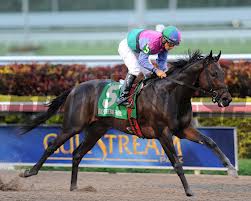
Showing posts with label Preakness Stakes. Show all posts

Thursday, February 27, 2014

Mine That Bird

 On May 10, 2006, a small bay colt was born in Kentucky out of Mining My Own, with the Birdstone being the sire. As a yearling, Mine That Bird was sold to a Canadian horse trainer, David Cotey, for $9,500 and put into training in Canada. He had a nasty temperament at first, so they gelded him not long after he went into training.

 Mine That Bird began his racing career in Canada, winning four of six races, including the Silver Deputy Stakes, the Swynford Stakes, and the Grey Stakes, with jockey Constant Montpellier riding the gelding for the first two races and Chantal Sutherland aboard for the last four. By the end of his two-year-old season, he had become Cananda's Champion Two-year-old Male Horse of 2008.

 After his successful first racing season, Mine That Bird was sold for $400,000 to a ranch in New Mexico and was put under the trainer Bennie "Chip" Woolley with the jockey Calvin Borel. He arrived just in time for the 2008 Breeders' Cup Juvenile, but finished last among twelve starters.

 He didn't race again until 2009, during his three-year-old season. The season didn't begin with a any wins, starting with Mine That Bird finishing second in the Borderland Derby on February 28, then fourth in the Sunland Derby on March 29. Despite the losses, Mine That Bird qualified for the Kentucky Derby, which would be his first race that year outside of New Mexico. He arrived at the as an underdog, his odds being 50-1.

Mine That Bird in the Kentucky Derby.
credit
 The night before the big race, rain poured down, leaving the track muddy and sloppy. Mine That Bird had trouble at the starting gate that race, leaving him eight lengths behind everyone else. By the time the rest of the pack was travelling down the backstretch, it seemed impossible for Mine That Bird to catch up. Calvin Borel urged the gelding onward, travelling along the inside rail to save time and distance. When Mine That Bird caught up with the rest of the pack, he zoomed passed them from the inside, taking the lead near the homestretch. Remarkably, he won by six lengths against horses whose odds were much better than his.

 After his amazing performance in Kentucky, which many people considered a fluke, Mine That Bird entered the Preakness Stakes under the jockey Mike Smith since Calvin would be riding Rachel Alexandra. Mine That Bird again started out slow and came from behind to pass the rest of the pack, but he was unable to catch up with Rachel Alexandra. He finished second behind her by only a length.

 Next, he entered the Belmont Stakes and was once again ridden by Calvin Borel. He came from behind, catching up with Dunkirk and Charitable Man near the end, but ended up third to Summer Bird and Dunkirk.

 He then came third in the West Virginia Derby and ninth in the Breeders' Cup Classic, ending his career. Afterward, he was nominated as New Mexico's 2009 Horse of the Year.

Thursday, May 23, 2013

Seattle Slew: Three-Year-Old Season


 Seattle Slew, known as the "People's Horse," began his three-year-old season as a favorite for the Kentucky Derby. He first won a seven furlong race at Hialeah, running in the track record time of 1:20 3/5, followed by victories in the Flamingo Stakes and the Wood Memorial Invitational Stakes.

Seattle Slew after the flamingo Derby.
(Credit)
 By the time the Derby rolled around, critics were saying that the lightly raced three-year-old wouldn't stand a chance. Seattle Slew was agitated during the post parade, and was foaming around the mouth, proving to the doubters that he would tire easily. 

 Seattle Slew banged his face on the starting gate right at the beginning, nearly throwing jockey Jean Cruguet. For the Moment took the early lead. Despite his slow start, Seattle Slew caught and passed the leaders within the first quarter mile, leaving the early leaders to fade away.

Seattle Slew winning the Kentucky Derby.
(credit).
"He broke slowly. He was shut off immediately. He had to overcome adversity. And then he went on to do what he was supposed to do. That's the sign of a racehorse," said Billy Turner, Slew's trainer. 

 Seattle Slew won the Preakness in the same manner two weeks later. He ran the fastest opening mile on record, easily passing Iron Constitution, Run Dusty Run, J.O. Tobin. After that, he almost effortless won the Belmont Stakes, becoming the first Triple Crown winner to win all of the classics as well. Furthermore, he became the first Triple Crown winner to be purchased at an auction. Eight others had been raced by their breeder and Sir Barton had been sold privately. 

 After his impressive victories in the Triple Crown races, many people offered to by him, including a $14 million from someone from Texas. Slew became so popular that his owners made tee-shirts, cocktail glasses, and rings featuring the young star. Companies, wanting to gain popularity, featured Slew in their advertisements. 

 However, the star didn't remain undefeated for long. Mickey Taylor and the rest of the crew raced him in the Swaps Stakes two weeks after the Belmont against Billy Turner's advice. Consequently, Slew lost to the English champion J.O. Tobin.

 The Taylors and the Hills took a lot of criticism for Slew's defeat. When Bill Turner told the press that the star should have never entered that race, Mickey fired him. Then Slew suffered from respiratory infections and a near-fatal virus. Even so, he was name 1977 Horse of the Year. 

Monday, May 20, 2013

Oxbow Upsets Orb in the Preakness Stakes

 In the Saturday's Preakness Stakes, Orb got stuck in traffic, leaving Oxbow to take the lead and win. Itsmyluckyday was second, followed Mylute and Orb.


Assault: Three-Year-Old Season

 Assault began his three-year-old season with a victory at the Experimental Handicap, followed by the Wood Memorial Stakes. 

 In the the Derby Trial, he placed fourth, with Rippey, Spy Song, and With Pleasure in front of him. Fans began to doubt whether or not he had it in him to win the Derby. 

Assault in the winners circle(photo credit).
 The Kentucky Derby came not long afterward. Lord Boswell was the betting favorite, and Assault was the fourth favorite. When Spy Song took and early lead, Assault followed close behind, catching him and winning by eight lengths, a distance that equaled the Kentucky Derby's longest length victory. However, he missed Whirlaway's time by over five seconds, running only 2:06 3/5.

Assault was made the betting favorite when he ran against Lord Boswell and eight others in the Preakness on May 11. Assault was boxed in early in the race, and was forced wide in the backstretch as he passed Natchez. All the way down the homestretch, he held the lead, with Lord Boswell four lengths behind him. Despite fatigue, he crossed the finish line a neck ahead of his rival. 

 Lord Boswell was the favorite in the Belmont Stakes in spite of Assaults victories. Fans believed that he was more suited to longer distances because of his near victory in the Preakness, especially since Assault had been exhausted at the end of the race. Assault was the second favorite. 

 Assault stumbled at the start, so Hampden took the lead right away. Assault didn't make his move until he neared the first turn, when he gave all he could, passing Natchez and winning by three lengths. Even though the race had been exciting, fans still doubted the seventh Triple Crown winner.

 Two weeks later, Assault won the Dwyer Stakes, but his time was unimpressive, and fans just thought he was the best of that group of of three-year-olds. He next lost the Arlington Classic. When he returned to the barn, he was diagnosed with a kidney infection.

 A month later, he was back on the track. He finished third behind Mighty Story in the Discovery Handicap, then second behind Mahout in the Jersey Handicap. On September 25, he met Stymie for the first time. Stymie was famous for winning from-the-behind, and his career had begun with cheap races, until he became Champion Handicap Horse in 1945. A rivalry was born from the day they first met.

 Stymie won their first meeting, the Manhattan handicap, and Assault cam third. After losing by a neck to Bridal Flower in the Roamer Handicap, he once more challenged his new rival, this time in the Gallant Fox Handicap. Once again he came third.

 In the Pimlico Special, the two met again. Eddie Arcaro, who was riding Assault for the first time, was told not to make a move until Stymie did. Assault ended up winning his first race since the Dwyer Stakes, beating both Bridal Flower and Stymie. 

 Assault won by two lengths in his final start that season, the Westchester Handicap. Despite his losing streak, he earned Horse of the Year honors and was named leading money winning. He had earned $424,195, and had won eight out of fifteen races that year.


Saturday, May 18, 2013

Count Fleet: Three-Year-Old Season

 Count Fleet began his three-year-old career with an easy victory in the St. James Purse, a mile and seventy yards long race. Then he won the Wood Memorial, a mile and three-sixteenths long race, with a time of 1:43, making quality horses like Blue Swords and Slide Rule look cheap. However, in doing so, he banged his left hind leg, threatening his chances of entering the Kentucky Derby. Even so, he did race. Johnny Longden held ice of the wound the whole time, and Count Fleet won despite his injuries. Once again, Blue Swords came second and Slide Rule third.

 The Preakness told the same story: Count Fleet first and Blue Swords second. The Blood-Horse magazine said, "If Count Fleet is the spectacular comet in the racing skies of 1943, then Blue Swords is the comet's tail."
Count Fleet in the winner's circle at one of the tracks
he raced on(photo credit).

 Count Fleet ran in the Withers stakes between the Preakness and the Belmont. He won by six lengths, with Slide Rule, who had skipped the Preakness, second.

When the Belmont finally came, the owners of Blue Swords and Slide Rule decided to skip it, not wanting to be humiliated one more time. Count Fleet only had to beat two horses, which he did easily. In fact, he won by six lengths, becoming the sixth Triple Crown winner.

 Count Fleet retired due to an injured fetlock soon afterwards. His retirement came as a relief to the owner of Blue Swords, who had been beaten several times.

 He enjoyed great success at stud, producing stake winners and the 1952 Horse of the Year. Count Fleet passed away on December 3, 1973, and is buried at Stoner Creek.

Thursday, May 16, 2013

Preakness Stakes 2013

Just two weeks ago, Orb came from last to first in the Kentucky Derby, just as Secretariat always has done. Now it is time for the Preakness Stakes this weekend. Lots of talk has been going around about whether or not he will win the Triple Crown. If you're a racing fan, or are just interested, it is important to know what he is up against(to learn about the pedigrees of the horses that were in the Derby, see Kentucky Derby Part 1, Part 2).
Itsmyluckyday(photo credit)
Itsmyluckyday did well as a two-year-old. He came second
in his first race, a five furlong one, and won his second,
a four furlong race. Then he placed third in the Tyro Stakes.
Next he won both the Fasig Tipton Turf Dash and the
Foolish Pleasure Stakes before coming sixth in
Delta Downs Jackpot. He finished the season fourth in the
Dania Beach Stakes. This year, he debuted with a victory
in the Gulfstream Park Derby, followed by a second
victory the Holy Bull Stakes. He then came second
in the Florida Derby. Most recently, he came
fifteenth in the Kentucky Derby.
Govenor Charlie(photo credit)
Govenor Charlie never raced last year, and was
lightly raced this year. He only raced three times this year.
His first race was a six furlong one at Santa Anita in which he placed
second. The next was a one mile long race, also at Santa
Anita, and he placed first. His most recent race is the Sunland Derby,
one and one eighth miles long. He won that one, too. Though he doesn't
have the experience that the others do,  he certainly has the talent.
His sire and dam are Midnightlute and Silverbulletway.
Oxbow(photo credit)
Last year, Oxbow only raced five times. He came seventh in a five and a half
furlong race at Saratoga. Following that, he ran three seven furlong races,
coming fourth in the one at Keeneland and third and first in the two at Churchill
Downs. Afterwards, he placed fourth in the CashCall Futurity.
He started this year's season with a victory in the LeComte Stakes.
Then he placed fourth in the Risen Star Stakes, second
in the Rebel Stakes,  fifth in the Arkansas Derby and
sixth in the Kentucky Derby.
Will Take Charge(photo credit)
Last year, Will Take Charge came fifth in a five and a half furlong
race at Saratoga before winning a seven furlong race at Keeneland.
Then he came thirteenth in the Kentucky Jockey Club. Next
he finished second in the Remington Springboard Mile.
This year, he won the Smarty Jones Stakes, came sixth in
the Southwest Stakes, then won the Rebel Stakes. He came eighth in
the Derby.
Mylute(photo credit)
Last year, Mylute began his career with third place in a five and half
furlong race at Churchill Downs. Then he came second in the
Praire Gold Juvenile, another five and half furlong race,
and first in a six furlong race at Arlington Park. After that
he came fifth and second, respectively, in the mile long  Arlington-Washington
Futurity and the Jean Lafitte Stakes. He then came third in the
Delta Downs Jackpot, first in a mile and seventy yards race,
seventh in the Risen Star Stakes, second in the Louisiana Derby,
and fifth in his most recent race, the Kentucky Derby.

Departing(photo credit)
Departing is one of the three horses entering in the Preakness
that never made it to the Derby. He raced only once last year,
coming first in a six furlong race. This year, he came first
in a one mile and seventy yards long race, and in the mile long
Texas Heritage race. After that, he came third in the Louisiana
Derby. In his most recent race, the Illinois Derby, he finished first.
His sire and dam are War Front and Leave.
Titletown Five(photo credit)
Titletown Five never raced in the Derby. Maybe it is because he has
not won a single race this year. He did, however, come fourth in the Derby
Trial. He came ninth in this year's Louisiana Derby and
second in a six furlong race in Oakland. Last year, he was
luckier. He came second in a seven furlong race at Saratoga,
and fourth in a five furlong race also at Saratoga. Before that,
he came third in a four and a half furlong race at Churchill.
His sire and dam are Tiznow and D'Wildcat Speed.

Goldencents(photo credit)
Goldencents is the type of horse that takes and early
lead and tries to hold it wire to wire. However, he
failed in the Kentucky Derby and placed 17th,
with only two horses behind him. Most of his races
have been done in California. He placed first
in both the Sham Stakes and Santa Anita Derby
at Santa Anita, but came fourth in the
san Felipe Stakes, also at Santa Anita.
In 2012, he came first in the Delta Downs Jackpot
at Delta Downs and in a five and a half furlong
race at Del Mar. His only race besides the Derby
outside of California was the Foxwoods
Champagne, at Belmont.
Orb(photo credit)
Orb has an excellent percentage of wins. All of them
are at distances over a mile, which greatly affects his chances
of being a Triple Crown winner. Three of his races are
at Gulfstream, in the Florida Derby and the
Fountain of Youth, while the other is at
Aqueduct. He has place third in a
seven furlong race, and fourth in a six and a half furlong race and
in a one mile race at Belmont. And, of course, is his incredible
win in the Derby. It was amazing to see him zip from last to
first place in the mile and a quarter race to win by
two and a half lengths.


Whirlaway: Three-year-old Season

 Whirlaway returned to the track in 1941. In his two races before the Kentucky Derby, he bore to the outside, afraid of the inner rail, which cost him the races. Because of that, Ben Jones trained him at home by running him between the rail and another horse. This may have made all the difference in the Derby.

 Equipped with a modified one-eye blinker and an experienced jockey, Eddie Arcaro, Whirlaway ran a somewhat straight line, winning by eight lengths and running 2:01 2/5, a new track record. Then rumors that Whirlaway had been using drugs began to spread. Even the usually calm Ben Jones was angry at the serious accusations.

Whirlaway in the Kentucky Derby winner's circle(credit).
 Nevertheless, Whirlaway proved himself in the Preakness Stakes. He was far behind the other horses after leaving the gate, and it seemed that he would not win. Then he made his move. He sped down the backstretch, passing every single horse for a win of five and a half lengths. It was incredibly breathtaking.

 By the time the Belmont Stakes rolled along, people were scared of Whirlaway's bursts of speed, so only a field of four horses ran that day. Whirlaway's three challengers tried to upset his strategy by setting a slow pace early on, but Eddie Arcaro had anticipated that, and cruised along right past them. He became Calumet Farm's first of two Triple Crown winners(see Citation).

 Whirlaway won several races after that. He beat Market Wise in the Dwyer Stakes, then won the American Derby, the Travers Stakes, defeated War Relic in the Saranac Handicap, and won the Lawrence Realization.

 However, oddly enough, the best race of his career is considered Jockey Club Gold Cup. He and Market Wise had battled throughout the race at a tremendous pace, until Market Wise finally won by a nose, setting a new American record of 3:20 2/5 in the process.

 Near the end of the 1941 season, Whirlaway was sent to the west cost to race there, but the bombing of Pearl Harbor cut the season to and abrupt end. He couldn't return home right away, because World War II travel restrictions. It wasn't until March the next year that he could finally leave.

 Despite the restrictions, he was still successful, and was named 1941 Horse of the Year and Champion Three-Year-Old Colt.

Monday, May 13, 2013

War Admiral: Three-Year-Old Season

 In spring of 1937, War Admiral began his three-year-old season with a victory in a six furlong(1320 yards) at Havre de Grace. Then, after delaying the start of the Chesapeake Stakes by seven minutes, he easily won by six lengths.

 After that was the Kentucky Derby. Once more, he delayed the start, this time by eight minutes. Even so, War Admiral took off, defeating a rival from his two-year season, Pompoon, by one and three-quarters lengths. Just after that, War Admiral headed to Baltimore for the Preakness Stakes.

 In that race, Pompoon put up a fight. He caught up to War Admiral on the first turn, and the two battled it out from there. War Admiral came out victorious, winning the black-eyed susans, and that years Preakness is considered one of the most exciting in history.
War Admiral won the Preakness after battling
for first place with Pompoon, a rival from his
year as a two-year-old(photo credit).
 Then came the Belmont Stakes, the ultimate test for a Derby and Preakness winner. Then, while War Admiral was battling into the starting gate, disaster struck: He had sliced of part of his right heel in his fight. His injury made him even less likely to win. However, despite his injury, he led from start to finish, tying the American record for one and half miles with a time of 2:28 3/5 and becoming the fourth Triple Crown winner. He made it look effortless.

 Later that fall, after recovering from his injury, he easily won at Laurel. Then He and Seabiscuit, an older champion, were going to match race in the Washington Handicap, also at Laurel. Racing fans all over the U.S. eagerly anticipated the match race. Yet it never happened. Seabiscuit, who was poorly trained, was scratched at the last minute, and War Admiral was given the desired victory. He finished the season with a victory on the Pimlico Special.

 War Admiral received Horse of the Year honors that year, but it was Seabiscuit who became the year's leading money winner. Seabiscuit had won just $2,080 more than War Admiral's $166,200.

Wednesday, May 8, 2013

Omaha: Three-Year-Old Season

 In 1935, Omaha began his racing season at Aqueduct, where he won, then moved on to the Wood Memorial. He came third by only a nose. Next he went to the Kentucky Derby as the second favorite, the favorite being Man o' War's daughter from Calumet Farms, Nellie Flag.

 Also racing was the victor of that year's Wood Memorial,Today, and Hopeful Stakes winner Physic Bid, and Boxthorn, the third betting favorite. Omaha ended up taking the lead in the backstretch, winning by a length and a half. Nellie Flag had been caught in traffic, and consequently finished fourth behind Roman Soldier and Whiskolo.

 The Preakness came a week later. Omaha almost effortlessly won by six lengths, with a horse known as Firethorn second and Physic Bid third. By the time the Withers Stakes came along between the Preakness and the Belmont, people began to question Omaha's ability to claim the Triple Crown, like his sire before him. Things became worse when he lost by a length and a half in the Withers Stakes.

 On the day of the Belmont Stakes, when the track was slick and muddy, and the cloudy sky drizzled rain, making track conditions less than satisfactory, Omaha made an attempt to follow in his sire footsteps. The horse named Cold Shoulder took an early, followed by Firethorn. Firethorn led well into the backstretch. Then, in one last desperate drive, Omaha gave his all, passing the leaders and becoming the third Triple Crown winner.

In the Brooklyn Stakes, Omaha lost some of the respect he had just earned, as well as Horse of the Year honors. Then he won the Dwyer Stakes, equalling Man o' War's time of 1:49 1/5. After that, he defeat Black Helen in the Arlington Stakes, and broke Sun Beau's record with the time 2:01 2/5. He had finally gained the status of national hero. Yet in the process, he pulled up lame at Saratoga. He was later sent to England for his next season.

Monday, April 29, 2013

Sir Barton: Three-Year-old Season

 In 1919, John Ross entered Sir Barton in the Kentucky Derby, not expecting him to win. In fact, he planned that Barton would actually lose so that the favored Billy Kelly would win. Barton's primary purpose was to take an early lead, tiring out fast Eternal and Under Fire so that Billy Kelly could take the lead and win.

 However, the plan backfired. Billy Kelly failed to catch Sir Barton on the homestretch, and placed second, five lengths behind his stablemate. Eternal had finished tenth.

 Then came the Preakness, only four days after the Derby. Sir Barton easily won by by four lengths, defeating both Eternal and Dunboyne, the previous year's Futurity Stakes winner.

 After that, Barton once more defeated Eternal, this time in the Withers Stakes on May 24.

Sir Barton after winning a race(click here for photo credit)
 Next, he won the Belmont Stakes, effortlessly defeating the American time for a mile and three-sixteenths(the Belmont Stakes was only that long back then) with his time of 2:17 2/5. At the time, the three races(the Kentucky Derby, Preakness Stakes, and Belmont Stakes) were not known as the Triple Crown. They were officially given that title in the 1930s. Even so, Sir Barton is still considered the first Triple Crown winner.

 Sir Barton lost for the first time since his streak began in the Dwyer Stakes. Purchase, the first winner of the Jockey Club Gold Cup, defeated him. Billy Kelly, however, was becoming a top sprinter, and defeated Barton five times that season, including in the six furlong sprint at Havre de Grace. Barton avenged his defeat in the Potomac Handicap, despite his 132 pound burden.

 He then finished second to The Porter, and third in the Havre de Grace Handicap, with Cudgel and Exterminator in front of him. In the Maryland Handicap, he beat the older Mad Hatter by two lengths. Mad Hatter then came back and defeated Barton in the next race, the Pimlico Autumn Handicap.

 Barton made a come-back when he won the other two races in the Pimlico fall serial, defeating bother The Porter and Billy Kelly. With the three-year-old record of eight wins and thirteen starts, Barton received Horse of the Year honors


Friday, April 19, 2013

Man o' War: Preakness Stakes, Withers Stakes, and Belmont Stakes

By the time the Kentucky Derby of 1920 rolled along, Man o' War was acknowledged as a fierce competitor, and everyone was afraid to race their own horses against the Big Red, as he was known. However, Big Red did not run in the Kentucky Derby. Samuel Riddle, his owner, believed that May was too early for three-year-old horses to race. Consequently, seventeen horses ran the Derby in his absence.

 The next week, only a handful of Derby entrants had the guts to run against Big Red in the Preakness at Pimlico Park in Baltimore. It would be 1 3/16 miles long, quite a distance for young horses. Nevertheless, Big Red took and early lead, fending Upset off in the homestretch and winning by 1 1/2 lengths. He ran a fast time of 1:51.3 seconds.

 Next came the Withers Stakes. Only two horses raced against Man o' War, who was only carrying 118  pounds in the mile long race. He won easily, beating the second-placer, Wildair, by two lengths, and setting a new American record of 1:35 4/5.

 Then he ran in the Belmont Stakes(1 3/8 miles), which was pretty much a match race between him and Donnacona, the only horse who accepted the challenge. Both horses carried 126 pounds. Even so, Big Red easily drew away from Donnacona, breaking Sir Barton's American record by over three seconds with a time of 2:14 1/5. This made his time a new world record! In addition, he beat Donnacona by 20 lengths!

 Undoubtedly, Man o' War was the greatest racehorse of his time. Every racing fan had no doubt that he would succeed in his next race, the Stuyvesant Handicap. They would just have to wait and see.

Tuesday, March 19, 2013

Secretariat: the Preakness Stakes

I also painted Secretariat in the winner's circle in Baltimore.
Two weeks after his impressive win at Churchill Downs, Secretariat advanced to the the Preakness Stakes,  the second Triple Crown race which is held in Baltimore, Maryland. Many people expected another Kentucky Derby where he would beat the track record.

 Secretariat, as was to be expected, began the race at the back of the field of six. Each of the horses were being directed by their jockeys to go slow to preserve energy for the 1 3/16 mile long race ahead of them. However, Ron Turcotte, Secretariat's jockey, had different plans.

 Instead of lingering at the back of the pack as usual, he urged Secretariat to make the risky maneuver of taking an early lead and attempting to hold first place until the end of the race. At the first turn, Secretariat was 2 1/2 lengths ahead of the second-place horse, Sham.  The other riders remained ready to burst ahead should Secretariat falter. Secretariat did not falter, and he ended up holding first place from start to finish. He beat Sham by 2 1/2 lengths.

 Even though Secretariat had won the race, a great controversy arose afterwards. The large digital clock showed his time to be 1:55--one second slower than that of Canonero, who at the time held the track record. In contrast, the track's clocker's watch stated that his time was 1:54 2/5, and two men from the Daily Racing Form showed that his time was 1:53 2/5.

 The following day, TV stations such as CBS showed reruns of both Canonero's and Secretariat's races. They allowed fans themselves to time the video clips and thus draw their own conclusion. Several days later, after much controversy, an official statement was made: Secretariat's time was 1:54 2/5.(Daily Racing Form still noted their timing of 1;53 2/5)

  Yet his most avid fans were not too concerned about his time. It had been twenty-five years since a horse had last one all of the races in the Triple Crown, and they all knew that if any horse could do it, Secretariat sure could.


Don't miss the other posts on the Triple Crown.