Showing posts with label bone bruises. Show all posts

Saturday, January 18, 2014

5 Common Sport Horse Injuries, Part 2

Continued. See Part 1
Bone Bruises
 A bone bruise is bruising of the bone, commonly occuring in the cannon and pastern bone. It is caused when tremendous force is concentrated in one of these areas, causing damage to the bones. Fluid builds up inside the bone and swelling occurs. Because bone bruises are caused by a hard impact, this kind of injury is most common in jumpers and eventers, or horses that are worked on hard ground.

 Bone bruises are very painful, despite the fact that they are small and hard to identify without proper equipment. Nuclear bone scans often view a bone bruise as a hot spot, yet pinpointing it exactly with that machine is difficult. The best way to locate it is by using a magnetic resonance imaging(MRI) scan.

 The time the horse will need off varies depending on how bad the bruising is, but average he will need to rest for three months before continuing work. Veternarians recommend using anti-inflammatory medications, such as Equioxx, to help with the injury. According to Nan Martin, wintergreen, cypress, and helichrysum are great natural alternatives for bone injuries.

Inflammed Joints
 Sometimes, the tissue lining a joint can become inflammed, which if not treated can eventually lead to osteoarthritis. This type of injury can occur in any horse, particularly when the horse's workload suddenly increases. Signs include soreness, stiffness, and less fluid gaits. His joints may swell and feel hot. 
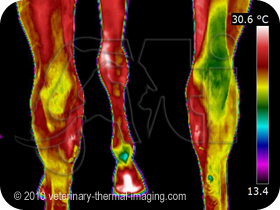
The red represents inflammation. credit
 The best way to treat this injury is give the horse a stall rest and cold-hose his joints daily until they are no longer hot. You also want to reduce inflammation in his joints, which can be done using anti-inflammatory medication. According to Nan Martin, Thyme, Bergamot, and Eucalyptis have been known to work in the same manner. Recovery may take a week or more, depending on the severity of the inflammation. Once your horse has recovered, gradually increase his work load and plan the most intense workouts several days or more apart from each other.

Sore Muscles
 It is natural for muscles to be a little sore after a workout, but sometimes they become strained, which commonly occurs in dressage horses, who must work hard to maintain a collected frame. As a result, his back may hurt and become stiff. He may also be resistant to bend, turning, and collecting.

 In the scenario that the pain and stiffness does not disappear after rest, or it if reappears, search for other causes, such as a poorly fitting saddle or an unbalanced rider. Massage, chiropractic work, acupressure, or even a thorough currying have been known reduce soreness. Combining massage with essential oils is said to increase it's affectiveness.
 ***
 Remember to always be aware of your horse's condition and well-being. Detecting problems early on can prevent more serious problems from arising, keeping your horse healthy and possibly saving you money in the long run. 

Friday, January 17, 2014

5 Common Sport Horse Injuries, Part 1

 Just like human athletes, sport horses, too, are prone to injuries. Jumping, when joints and muscles are strained on impact, can cause considerable damage, particularly if the horse misteps or stumbles, which can cause a torn ligament or tendon. Among the myriad injuries a horse can obtain, the most common are: suspensor ligament injuries, deep digital flexor tendon(DDFT) damage, bone bruises, inflamed joints, and sore muscles.

A diagram of the tendons and ligaments in the leg. Notice the
 suspensory ligament and deep digital flexor tendon. credit
 Suspensory Ligament Injuries
 The suspensory ligament runs down the back of the cannon bone, starting just below the knee or hock and divinding into two branches, ending at the pastern. The ligament supports the ankle when weight is put on it, though if too much pressure is applied, it may tear or rupture. This can occur in the front legs when jumpers or eventers mistep upon landing on the other side of an obstacle, stressing the ligament. Dessage horses will most likely injure their hind leg suspensory ligaments as they work off their hind ends.

 Spotting an injury in the suspensory ligament can prove difficult, since part of it is covered by other structures and the horse may only display subtle signs of lameness, depending on the severity of the tear. The leg may be warm, swollen, and sensitive. The best way to tell is by having your veterinarian exam you horse. An utlrasound can readily discover how severe the damage is and even locate the exact place of the tear. X-rays can show if the bone is damaged as well.

 Depending on the severity of the situation, your vet will recommend several things. He will most likely tell you to cold-hose the leg daily, give your horse a stall rest, hand walk him short distances, and slowly return to the usual workload. This can take as short as eight weeks, or as long as a year. In more severe cases, your vet may recommend surgery or shockwave treatment.

 Regardless of how severe the injury is, you should do something to reduce inflammation. Most vets recommend phenylbutazone(bute) and Banamine. Natural alternatives, recommended by Nan Martin, include lemongrass and marjoram, which is known to not only reduce inflammation and aid the healing of muscles, but also alleviates pain.

DDFT Damage
 The deep digital flexor tendon, as the name suggests, assists with flexon of the leg. It runs from the back of the leg to the bottom of the coffin bone. Most commonly, a sport horse will the tear the bottom part, which runs from the pastern to the hoof, when his weight passes over his toe and his heel lifts. This occurs when jumping or working at high speeds, such as in the gallop.

 Because the injury can occur to the part of the tendon residing in the hoof, spotting this condition can be particularly hard. If it occurs in the pastern or above the heal, you may notice it due to heat and swelling. Otherwise, it can be next to impossible to notice it, even with ultrasound, unless you go to a clinic with a magnetic resonance imaging machine.

 Just like with a torn ligament, you should cold-hose the injured area and give your horse a stall rest of about eight weeks if the tendon has only been spranged, or eight months or more if the tendon has been torn. Try to reduce the inflammation to aid healing and reduce pain. As I mentioned earlier, lemongrass and marjoram are commonly used to reduce pain and inflammation. Your vet may recommend special shoes. Don't rush things, and slowly work your way up the training schedule you had before the injury.

Stay tuned for Part 2 to read about three more common injuries.