Showing posts with label Russian Orlov. Show all posts

Tuesday, February 4, 2014

Orlov Trotter

History
In the late 18th century, Count Aleksey Orlov, a professional horse breeder, wanted to create a fast horse able to pull the troika, a type of Russian sled pulled by three horses abreast. He began by breeding a gray Arabian stallion named Smetanka to a Danish mare named Isabelline, producing Polkan, who was bred to a Dutch mare. His offspring, Bars I, began the first Orlov Trotter and the foundation for the breed.

 During the 19th century, it was considered to be the best harness-racing horse, not just in Russia, but throughout Europe, though it was used only by Russian nobility. However, before long Europeans found out about the Standardbred, an even faster trotting horse, so the Orlov Trotter was crossed with the faster breed. The result was the Russian Trotter, a faster, yet less beautiful breed.
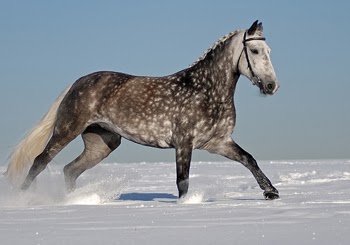
Orlov Trotter

 With the creation of the Russian Trotter came devestating problems for the Orlov Trotter. Cross-breeding became so popular that the breed dwindled until it came near extinction. Only after 1920 did people begin raising pureblooded Orlovs again. When that happened, they bacame almost as popular as they once were. However, this didn't last long. During World War II, the breed once again diminished.

 The Orlov Trotter first came to America in 1959, when Soviet leader Nikita Khrushchev gave several to Ezra Taft Benson, the America secretary of agriculture. Americans loved the breed, but it was still rare, and in 1997, the International Committee for the Protection of the Orlov Trotter was created.
Alexandra Korelova and Balagur credit

Breed Description and Uses
 Orlov Trotters are a large breed, growing a average of 15.2 to 17 hands high, and are strong and muscular. They have long legs, prominent withers, broad croups, arched necks, and large, beautiful heads, complete with the expressive eyes of the Arabian. Also like the Arabian, Orlovs are usually born dark, yet grey out as they mature, though some exceptions, such such as bay and chestnut ones, have occured.

 Orlovs are fast horses with the stamina of the Arabian, performing well not only in driving, as it was bred for, but also in dressage. As a matter of fact, a famous Grand Prix dressage horse named Balagur, who competed in the 2008 Olympic Games, is an Orlov Trotter.

Thursday, September 26, 2013

The Budenny

History
 After the Russian Revolution and World War I, with many equines having died in battle, the Russians needed to breed new mounts for the cavalry officers. Marshall Semyon Budenny, a respected Soviet general, began trying to create a perfect officer's mount in 1921. He looked for horses with favored characteristics–strength, sure-footedness, controllability, maneuverability, and spirit. Furthermore, the horse had to be be to survive on scanty rations and still be ready for action the next day.

 They achieved creating such a horse by crossing the Don, a native cavalry horse that traces back to Thoroughbreds, Arabians, and Russian Orlovs, with the English Thoroughbreds that had come over as racehorses in 1885. The best of the offspring was sent to the Budenny(pronounced bood-yo-nee) Higher Cavalry School, where they received training before becoming cavalry horses. Of this small amount of horses, only 10% of the mares and 5% of  the stallions were accepted as suitable breeding stock. In 1948, the horses were recognized as a breed and was named Budenny. In 1953, though, the USSR Calvary disbanded, changing the Budenny's role from a war horse to a sport horse.
If you really look at the Budenny, you can see the Thoroughbred in it.
source

 Today, only 2,500 Budennies have been registered, with only 600 of them being mares.

Breed Description and Uses
 The Budenny has received the best qualities from both the Thoroughbred and the Don. From the Thoroughbred came its flowing, agile movement; its long neck; its slender, strong legs; large bones, and pretty head, while it inherits its hardiness and calm from the Don. Standing around 16 hands high, the Budenny usually comes in various shades of chestnut, also inherited from the Don. One peculiarity of the breed is that it has the same metallic sheen in its coat as the Don and the Akhal-Teke.

 The Buddenny's temperament, intelligence, and trainability make it an excellent war horse. Often, it is known as a one-person horse because it bonds so deeply with its handler, bravely doing anything for him, whether that be bravely marching into battle or boldly soaring over fences. Also, Budennies are smart enough to think independently should their rider be otherwise occupied. At the same time, though, they will do what their rider asks of them, even if they had made another choice.

 The Budenny excels in dressage, jumping, steeplechase, and eventing, though its ability to recover quickly from a hard exercise makes it an ideal mount for almost any sport.