I had another lesson on Chester, the TB/Percheron gelding I will soon lease, today. I started the lesson by warming up with walk-halt transitions, as I always do, the began a trot circle to the left in the dressage part of the arena. As I did so I worked on sitting up straight and posting on the correct diagonal. The edges the the arena come up quickly with a big a horse like Chester, so at one point I didn't turn soon enough and ran into the P dressage letter cone, knocking it over.
After circling for a few minutes, I drank some water, then changed directions and started heading to the right.I was a bit better at posting on the correct diagonal right away, although a couple times Chester did some leg-yields, which Meghan said was because of uneven leg pressure. Chester is a sensitive horse and was unsure of what I wanted. I put him back of the circle and continued to ride him on it.
Then, I started riding at the trot around the entire dressage arena, heading right. The more I worked, the better my posture and posting became. I later rode across the diagonal from M to K so I could change directions.
Towards the end of the lesson, Meghan wanted to know if I wanted to canter. I did, so she put Chester on the lungeline I began a trot circle to the right. I was a bit nervous because I've only cantered a handful of times and had fallen last time, but after doing a few strides I was just fine. Chester's canter isn't as big and rocking horse-like as Ginger's, so it was consequently much easier to sit, though there was a moment when I almost went over, but I soon caught myself. I did several strides of canter at a time, three times. It was fun!
I then trotted a bit more and cooled Chester down by ride the path that encircles the barn and pasture. I told him he was a good boy, untacked and groomed him, then put him away. Wednesday, I'll have another lesson on him, this time with Jessica, his owner, watching. Afterward we will work out a lease. If all goes well, which most likely will, I will start leasing him at the beginning of next month. I'm excited! When I start leasing him, I will ride three to four a week! I can't wait!
In other news, I changed my blog name to The Aspiring Equestrian. I decided upon this name because I have aspirations when it comes to riding horses; many people who know me know I want to be a fourth level eventer someday. I thought the name was suiting!

Showing posts with label Percherons. Show all posts
Showing posts with label Percherons. Show all posts
Monday, June 16, 2014

Monday, June 9, 2014
Lesson on Chester--Potential Lease Horse!
After about a month off, I had a lesson today on Chester, the horse I may possibly lease. He is chestnut Percheron/Thoroughbred, so he is quite big at about 16 to 17 hands high. His sometimes owner leases him out to riders that ride with Meghan. In fact his previous leaser was a young girl about eleven, who just got her first horse. Chester is a friendly, even-tempered horse and doesn't seem to spook at much, although his temperament seems a little higher than unflappable Reno.
I led him from his paddock to the barn, only tying him up with his lead rope because he feels trapped when in the cross-ties. I brushed him, picked his hooves, then tacked him. Before I mounted Meghan told me a little more about Chester, telling me to make sure use light aids since Chester is sensitive and it doesn't take much to get him to go.
After mounting I made a circle to the left in the dressage part of the arena and got used to riding Chester. His walk seems much like what I read about in dressage books---forward and marching. I did some walk-halt transitions as I circled, then changed directions and did the same thing.
Next, I rode him at the walk around the dressage arena, doing several walk-halt transitions. Then I made a 20 meter circle at B, trotting part of it and working up to doing the whole entire thing. My reins weren't even, so he went to the outside after passing E. When I tried to turn him back, he thought I was asking for a leg yield and promptly began to do just that, heading left with his haunches toward the fence! It was my first time leg-yield, even if it wasn't planned. ;)
Anyways, I brought him back to the circle and continued to trot, working on keeping my heels down and shoulders back, as well as not occasionally looking down. I don't want to end up on the ground! It's a longer way down than from Ginger.
I soon moved to a circle at C, worked at the trot for a bit more. Now that he was more relaxed and warmed up, his trot was bigger, swinging smoothly forward. Not warmblood gaits but he has some pretty nice gaits.
I then began to cool him down, and Meghan said I could ride him on the trail the circled the barn and paddocks by myself(my parents followed). She said that trail riding is Chester's favorite thing. Chester was very relaxed, and Meghan let me ride I went around the short loop twice. We spent this time to get to know each other more.
After I put him away, we talked some more about the lease. Meghan said I could ride Chester in my lessons this month rather than Ginger or Reno. If all goes well I can start leasing him at the beginning of July! I'm really excited about this! When I lease I will be riding hopefully 2-3 times a week, or more, and will be able to take him out and ride outside of a lesson as well. This is going to be great! I can't wait to get to know him better.
I led him from his paddock to the barn, only tying him up with his lead rope because he feels trapped when in the cross-ties. I brushed him, picked his hooves, then tacked him. Before I mounted Meghan told me a little more about Chester, telling me to make sure use light aids since Chester is sensitive and it doesn't take much to get him to go.
After mounting I made a circle to the left in the dressage part of the arena and got used to riding Chester. His walk seems much like what I read about in dressage books---forward and marching. I did some walk-halt transitions as I circled, then changed directions and did the same thing.
Next, I rode him at the walk around the dressage arena, doing several walk-halt transitions. Then I made a 20 meter circle at B, trotting part of it and working up to doing the whole entire thing. My reins weren't even, so he went to the outside after passing E. When I tried to turn him back, he thought I was asking for a leg yield and promptly began to do just that, heading left with his haunches toward the fence! It was my first time leg-yield, even if it wasn't planned. ;)
Anyways, I brought him back to the circle and continued to trot, working on keeping my heels down and shoulders back, as well as not occasionally looking down. I don't want to end up on the ground! It's a longer way down than from Ginger.
I soon moved to a circle at C, worked at the trot for a bit more. Now that he was more relaxed and warmed up, his trot was bigger, swinging smoothly forward. Not warmblood gaits but he has some pretty nice gaits.
I then began to cool him down, and Meghan said I could ride him on the trail the circled the barn and paddocks by myself(my parents followed). She said that trail riding is Chester's favorite thing. Chester was very relaxed, and Meghan let me ride I went around the short loop twice. We spent this time to get to know each other more.
After I put him away, we talked some more about the lease. Meghan said I could ride Chester in my lessons this month rather than Ginger or Reno. If all goes well I can start leasing him at the beginning of July! I'm really excited about this! When I lease I will be riding hopefully 2-3 times a week, or more, and will be able to take him out and ride outside of a lesson as well. This is going to be great! I can't wait to get to know him better.
Wednesday, February 5, 2014
Percheron
History
The development of the Percheron breed began when Moors invaded the Perche region in Normandy in AD 732, bringing with them Barb horses. These horses were left behind after the Moors were defeated and were put to great use in creating the famous Percheron. They were crossed with huge Flemish horses, creating a large, muscular breed.
Originally, the Percheron was used as a war as a war horse, bringing many soldiers into battle, but as time went, such horses were no longer needed, so the role of the Percheron changed to that of a carriage. The Percheron was well-fitted for the job for several reasons. It was(and still is) elegant, strong, and able to trot all day.
When the train was invented, providing a faster means of travel, the Percheron was once again out of a job. It didn't last long, though. People wanted fast horses to replace the oxen in agricultural uses, and others needed a strong, sturdy animal to haul heavy loads from the dock to the railroad, to be loaded onto trains. The Percheron fitted the job description.
Americans, too needed heavy draft horses, so a few Percherons were imported in 1839 and 1851, followed by a large number in the 1870s and 1880s. The Percheron increased in popularity, though World War I and the use of cars and trucks threatened the survival of the breed. By 1954, only 85 remained. Several people, however, were dedicated to breed, persevering until that number grew to over 2,000.
Today, Percherons have a much different purpose: sport. People cross them with various athletic breeds, including Thoroughbreds, warmbloods, and Spanish breeds, creating a large and strong, yet athletic horse that can be used in dressage, jumping, and eventing.
Breed Description and Uses
Though large and strong, standing 16.2 to 17.2 hand high, Percherons are more energetic than your typical draft breed. Their legs have no feathering, also uncommon among draft breeds, and they are born black, graying as they mature.
Many people use the Percheron for driving competitions, hay rides, and even dressage.
The development of the Percheron breed began when Moors invaded the Perche region in Normandy in AD 732, bringing with them Barb horses. These horses were left behind after the Moors were defeated and were put to great use in creating the famous Percheron. They were crossed with huge Flemish horses, creating a large, muscular breed.
Originally, the Percheron was used as a war as a war horse, bringing many soldiers into battle, but as time went, such horses were no longer needed, so the role of the Percheron changed to that of a carriage. The Percheron was well-fitted for the job for several reasons. It was(and still is) elegant, strong, and able to trot all day.
 |
| Percheron credit |
When the train was invented, providing a faster means of travel, the Percheron was once again out of a job. It didn't last long, though. People wanted fast horses to replace the oxen in agricultural uses, and others needed a strong, sturdy animal to haul heavy loads from the dock to the railroad, to be loaded onto trains. The Percheron fitted the job description.
Americans, too needed heavy draft horses, so a few Percherons were imported in 1839 and 1851, followed by a large number in the 1870s and 1880s. The Percheron increased in popularity, though World War I and the use of cars and trucks threatened the survival of the breed. By 1954, only 85 remained. Several people, however, were dedicated to breed, persevering until that number grew to over 2,000.
Today, Percherons have a much different purpose: sport. People cross them with various athletic breeds, including Thoroughbreds, warmbloods, and Spanish breeds, creating a large and strong, yet athletic horse that can be used in dressage, jumping, and eventing.
Breed Description and Uses
Though large and strong, standing 16.2 to 17.2 hand high, Percherons are more energetic than your typical draft breed. Their legs have no feathering, also uncommon among draft breeds, and they are born black, graying as they mature.
Many people use the Percheron for driving competitions, hay rides, and even dressage.
Friday, November 22, 2013
Highland Pony
History
The Highland Pony has been in Scotland for centuries, changing a little bit each time an invading army came to the area, bringing with them horses native to their country. Among those horses include Percherons, Hackneys, Fell Ponies, and Dales Ponies. Because of the many different bloodlines of horses within the breed, the breed has developed into two: a small, light one and a large, muscular one.
Due to their stamina, strength, and sure-footedness, the ponies were used for farm work, such as plowing, as well as hauling timber across the land and carrying deer back home after a hunting trip. During the second World War, the pony was used as a war horse.
Today, the pony is a favorite of Queen Elizabeth II, who owns the largest herd of stallions, which are bred during the breeding season.
Breed Description and Uses
The Highland Pony is small, standing only 13 to 14.2 hands high. His hooves are hard and solid, perfect for climbing the Highlands, and feathering covers his fetlocks. His hindquarters are powerful, chest deep, shoulder large, and neck arched with a pretty little head.
Highlands come in dun, gray, black, chestnut, and cream, and some come with dorsal stripes or zebra stripes on their legs.
Highland Ponies are still used as hunting ponies–not the jumping, though they are good at that too, but the kind when you stalk and shoot animals. They are also as a pack pony, and those crossed with Thoroughbreds make great eventers.
The Highland Pony has been in Scotland for centuries, changing a little bit each time an invading army came to the area, bringing with them horses native to their country. Among those horses include Percherons, Hackneys, Fell Ponies, and Dales Ponies. Because of the many different bloodlines of horses within the breed, the breed has developed into two: a small, light one and a large, muscular one.
Due to their stamina, strength, and sure-footedness, the ponies were used for farm work, such as plowing, as well as hauling timber across the land and carrying deer back home after a hunting trip. During the second World War, the pony was used as a war horse.
Today, the pony is a favorite of Queen Elizabeth II, who owns the largest herd of stallions, which are bred during the breeding season.
 |
| Highland Pony credit |
Breed Description and Uses
The Highland Pony is small, standing only 13 to 14.2 hands high. His hooves are hard and solid, perfect for climbing the Highlands, and feathering covers his fetlocks. His hindquarters are powerful, chest deep, shoulder large, and neck arched with a pretty little head.
Highlands come in dun, gray, black, chestnut, and cream, and some come with dorsal stripes or zebra stripes on their legs.
Highland Ponies are still used as hunting ponies–not the jumping, though they are good at that too, but the kind when you stalk and shoot animals. They are also as a pack pony, and those crossed with Thoroughbreds make great eventers.
Tuesday, October 15, 2013
Criollo Horse
History
During the early 1500s, Spanish conquistadors travelled to the New World, settling mostly in South America. They took horses of Barb descent with them. Many were lost or stolen, and began to run free across the Pampas(plains) of South America. Over the next few centuries, the number of feral horses in South America increased rapidly. At one point, in 1580, there were 12,000 of them galloping across the plains, though were captured over the years when settlers needed them for work.
However, there huge numbers began to change in the early 1800s when European invaders came to Argentina, binging with them Percherons and Thoroughbreds, both of which greatly increased the size of the breed. Before long, the Criollo was almost becoming extinct. Only 200, held by a south American tribe, remained. It wasn't until 1917, though, that the Sociedad Rural de Argentina began making efforts to save the breed. Upon discovering the small herd, they began a breeding program. The next year, a breed registry was made, and in 1923, the breed association was formed. Five years later, a breeder named Dr. Solanet, who was interested in the Chilean Horse, wanted the Criollo to become more compact and stock, like the horse he admired. In 1934, he took over the breed association. Soon, over 70% of the Criollo had been culled from the registry because they didn't fit the criteria, and the breed became more compact and stocky, like it is today.
Breed Description and Uses
Everything about the Criollo reflects strength and power. Standing 14.1 hands, it has muscular, sloping shoulders, a powerful crested neck, short legs and back, a sloping croup, and burly hindquarters. Most commonly, it comes in dun, but other coat colors can be found as well, including patterns with a dorsal stripe and zebra markings on the legs.
The Criollo is one of the best endurance horses. In fact, breeders often test the horse's endurance by having them travel 466 miles in 75 hours, divided evenly among 14 days. Despite the rigorousness of the test, no supplements of any kind are allowed. The horses must be able to make to the end without any performance-enhancing supplements.
During the early 1500s, Spanish conquistadors travelled to the New World, settling mostly in South America. They took horses of Barb descent with them. Many were lost or stolen, and began to run free across the Pampas(plains) of South America. Over the next few centuries, the number of feral horses in South America increased rapidly. At one point, in 1580, there were 12,000 of them galloping across the plains, though were captured over the years when settlers needed them for work.
However, there huge numbers began to change in the early 1800s when European invaders came to Argentina, binging with them Percherons and Thoroughbreds, both of which greatly increased the size of the breed. Before long, the Criollo was almost becoming extinct. Only 200, held by a south American tribe, remained. It wasn't until 1917, though, that the Sociedad Rural de Argentina began making efforts to save the breed. Upon discovering the small herd, they began a breeding program. The next year, a breed registry was made, and in 1923, the breed association was formed. Five years later, a breeder named Dr. Solanet, who was interested in the Chilean Horse, wanted the Criollo to become more compact and stock, like the horse he admired. In 1934, he took over the breed association. Soon, over 70% of the Criollo had been culled from the registry because they didn't fit the criteria, and the breed became more compact and stocky, like it is today.
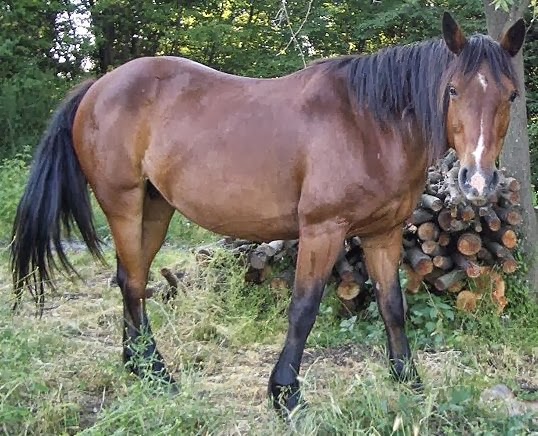 |
| Criollos are stocky, muscular horses, perfect for ranch work. |
Breed Description and Uses
Everything about the Criollo reflects strength and power. Standing 14.1 hands, it has muscular, sloping shoulders, a powerful crested neck, short legs and back, a sloping croup, and burly hindquarters. Most commonly, it comes in dun, but other coat colors can be found as well, including patterns with a dorsal stripe and zebra markings on the legs.
The Criollo is one of the best endurance horses. In fact, breeders often test the horse's endurance by having them travel 466 miles in 75 hours, divided evenly among 14 days. Despite the rigorousness of the test, no supplements of any kind are allowed. The horses must be able to make to the end without any performance-enhancing supplements.
Subscribe to:
Posts (Atom)