Showing posts with label Florida Cracker horse. Show all posts

Thursday, November 7, 2013

Florida Cracker Horse

 History
 In the early 1500s, many Spaniards came over to explore the New World, taking horses with them. A man named Ponce de Leon brought African Barbs with some Spanish blood in them to what is now Florida, making several breeding stations throughout the state.

 As their numbers grew, many of the horses escaped and formed large, wild herds across the state of Florida. The Seminole tribe, who lived in the area, captured some of these horses, but others were allowed to roaming free, natural selection choosing who would breed the next generation.

More settlers arrived in the 1700s, also capturing the horses, which they used in their cattle ranches, snapping bullwhips as they rode. Eventually, the breed was identified by the cracking sound of the whip, hence the name, "Florida Cracker Horse."
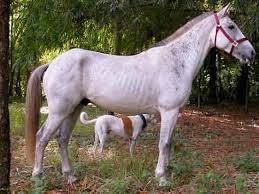
Florida Cracker Horses are light and nimble.
credit

The first blow to the popularity of the Crackers happened in the early 1900s, when tractors and other machines started to appear, making farm work much easier. The Crackers took another blow in the '30s, when screwworms began infecting herds of cattle. In order to rope the cattle to administer medication, ranchers needed the stronger Quarter Horses.

 In 1989, a group of people who loved the Cracker horse formed the Florida Cracker Horse Association. They planned to search for the remaining Crackers and create a herd and a registry. At first, only 31 horses were registered, but today, through the efforts of several families, who have bred them for their own use, that number has grown to 800.

 On May 2, 2008, the Florida Cracker, also known as the Florida Marsh Tacky was voted Florida's state heritage horse.

Breed Description and Uses
 Though the Cracker is not a pony, it stands a minimum of 13.2 hands and a maximum of 15 hands. The breed has wide-set, intelligent eyes; a nice neck, short back, sloping croup, and slender legs. Many Crackers are gaited and can do the flatfoot walk, running walk, and amble. They come in all solid colors, with greys being most common.

 Today, Crackers are often used for endurance racing, pleasure, and ranching activities, such as cow sorting.

Tuesday, October 1, 2013

The Carolina Marsh Tacky

History:
 The Carolina Marshy Tacky came to North America with the Spaniards, who were hoping to colonize parts of it. One man, Luis Vazquez de Ayllon, was hoping to colonize the coast of North and South Carolina, as well Virginia, in 1526. He brought with him approximately 500 people and 89 horses. However, the idea of creating a colony flopped, and the people who had not died there left within the year, leaving behind their horses.

 One herd had swam to the Shackleford islands, while the other remained in what is now South Carolina. The latter had to adapt to the harsh marshlands of the area, but once they did, they became a prized horse among local Native American tribes–Choctaws, Chickasaws, Cherokees, and Seminoles. When Europeans began settling North American, the sure-footed horse was used by them too. Francis Marion and his troops, who fought in the swamplands of South Carolina, used these horses during the Revolutionary War. The breed had become so popular by them that the British referred to them as "tacky," meaning "common."

Marsh Tackies are sturdy, sure-footed horses, able run effortlessly through
wetlands due to their flat, dish-like hooves. source
 However, the breed is not so common today. As cars arrived in South Carolina, the horses went out the back door, their numbers dwindling down to 300 in South Carolina alone. In 2006, the American Livestock Breed Conservancy got involved after having travelled to South Carolina to determine whether the breed still existed. After confirming their find using DNA testing, they created a studbook. By June of 2007, owners decided to form the Carolina Marsh Tacky Association. Today, the biggest herd is owned by the Carolina Marsh Tacky Association, consisting of 100 horses. In further attempts to preserve the breed, the Marsh Tacky became South Carolina's state heritage horse.

Breed Description and Uses:
Standing under 14.3 hands high, the Marsh Tacky is well-muscled, yet also refined with large, pan-like feet and the ability to be ridden all day without tiring, even over rough terrain. Consequently, it is commonly used as a trail horse. Most often, the Tacky is dun colored.

 As for the temperament, the Tacky is calm and unafraid of guns, which is why it is favored among hunters. Should it get stuck in a bog, it would calmly climb out, whereas most other breeds would likely panic.